Tin Foil and Its Combinations for Filling Teeth — John Shaqi
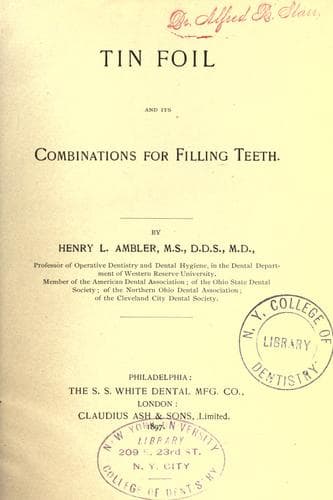
Tin Foil and Its Combinations for Filling TeethAmbler, Henry Lovejoy
Science
Tin Foil and Its Combinations for Filling Teeth
Ambler, Henry Lovejoy
Dentistry
"With tin and gold, some have the superstition that the electricity
attendant upon such a filling will in some way be injurious to the
tooth; it matters not which is on the outside, when rolled and used as
non-cohesive cylinders each appears. We say that neither experimentally,
theoretically, nor practically can any good or bad result be expected
from the electrical action of a tin-gold filling on tooth-bone, and
neither will the pulp be disturbed." (Dr. W. D. Miller, _Independent
Practitioner_, August, 1884.)
"When the bottom of a cavity is filled with tin which is tightly
(completely) covered with gold, there is _practically_ no galvanic
action and there is no current generated by contact of tin and
gold,--_i.e._, no current leaves the filling to affect the dentin. That
portion of tin which forms the base is more positive than a full tin
filling would be. The effect is to cause the surface exposed to dentin
to oxidize more than tin would do alone; in that there is a benefit. In
very porous dentin there is enough moisture to oxidize the tin, by
reason of the current set up by the gold." (Dr. S. B. Palmer.)
Electricity generated by heat is called thermo-electricity. If a cavity
with continuous walls is half filled with tin and completed with gold,
or half filled with silver and completed with gold, and the junctions of
the metal are at 20-1/2 deg. C. and 19-1/2 deg. C., if the electrical action
between the tin and gold be 1.1, the action between the silver and gold
will be 1.8, thus showing the action in silver and gold to be nearly
two-thirds more than in the tin and gold, a deduction which favors the
tin and gold.
Rubbing two different substances together is a common method of
producing an electric charge. Is there not more electricity generated
during mastication on metal fillings than when the jaws are at rest?
Friction brings into close contact numerous particles of two bodies, and
perhaps the electrical action going on more or less all the time through
gold fillings (especially when other metals are in the mouth) accounts
for a powdered condition of the dentin which is sometimes found under
cohesive gold fillings, but not under tin.
CHAPTER VI.
Public-domain text, read in full here on John Shaqi.
Reviews
Reviews
No reviews yet
Be the first to share your thoughts on this work.
Join the Discussion
Join the discussion
Sign in to leave a comment or review.
Sign InorCreate an account