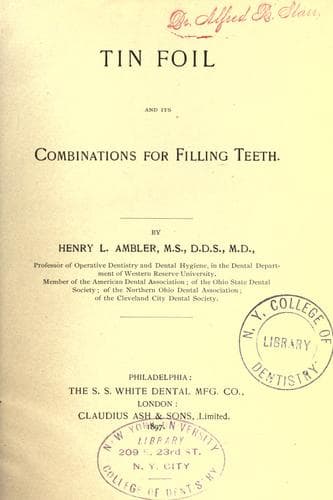
Tin Foil and Its Combinations for Filling TeethAmbler, Henry Lovejoy
Science
Tin Foil and Its Combinations for Filling Teeth
Ambler, Henry Lovejoy
Dentistry
White caries, the most formidable variety known, may be produced by
nitric acid, and in these cases all the components of the tooth are
acted upon and disintegrated as far as the action extends. In proximal
cavities attacked by this kind of caries, separate freely on the lingual
side, and fill with tin. When such fillings have been removed the dentin
has been found somewhat discolored and greatly solidified as compared to
its former condition; this solidification or calcification is more
frequent under tin than gold, which is partly due to the tin as a poor
conductor of heat. Nature will not restore the lost part, but will do
the next best thing--solidify the dentin. In some cases, under tin, the
pulp gradually recedes, and the pulp-cavity is obliterated by secondary
dentin. In other cases the pulps had partly calcified under tin. It has
been known for years that tin would be tolerated in large cavities very
near the pulp without causing any trouble, and one reason for this is
its low conducting power. Attention is called to the fact that gold is
nearly four times as good a conductor of heat as tin, and more than six
times as good a conductor of electricity. Where tin fillings are
subject to a large amount of attrition, they wear away sooner or later,
but this is not such a great detriment, for they can easily be repaired
or replaced, and owing to the concave form produced by wear the patient
is liable to know when a large amount has been worn away. That portion
against the wall of the cavity is the last removed by wear, so that
further caries is prevented so long as there is any reasonable amount of
tin left. If at this time the tooth has become sufficiently solidified,
proper anchorage can be cut in the tin or tooth, one or both, as
judgment dictates, and the filling completed with gold. A tin filling,
confined by four rather frail walls, may condense upon itself, but it is
so soft and adaptable that the force which condenses it continually
secures the readaptation at the margin; thus there will be no leakage or
caries for years. Owing to its softness and pliability, it may be driven
into or onto the tubuli to completely close them from outside moisture,
and with a hand burnisher the tin can be made to take such a hold on
dry, rough tubuli that a cutting instrument is necessary to remove all
traces of it.
Public-domain text, read in full here on John Shaqi.
Reviews
Reviews
No reviews yet
Be the first to share your thoughts on this work.
Join the Discussion
Join the discussion
Sign in to leave a comment or review.
Sign InorCreate an account