Tommy Atkins at War: As Told in His Own Letters — John Shaqi
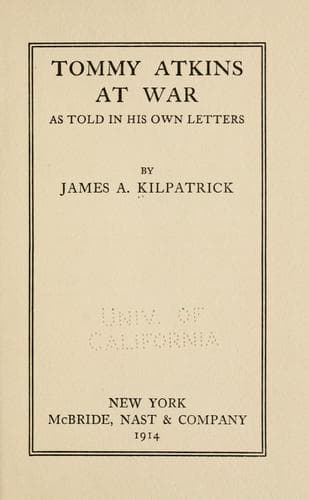
Tommy Atkins at War: As Told in His Own LettersKilpatrick, James Alexander
History
Tommy Atkins at War: As Told in His Own Letters
Kilpatrick, James Alexander
Great Britain. Army -- Military life; World War, 1914-1918
The Scottish Borderers speak proudly of Major Leigh, who was hit during
a bayonet charge, and when some of his men turned to help him, shouted
"Go on, boys; don't mind me." A lieutenant of A Company, 1st Cheshires:
"I only know his nickname," says Private D. Schofield--though wounded in
two places, rushed to help a man in distress, brought him in, and then
went back to pick up his fallen sword. Captain Robert Bruce, heir of
Lord Balfour of Burleigh, distinguished himself in the fighting at Mons.
One of the Argyll and Sutherland Highlanders relates that, in spite of
wounds, Captain Bruce took command of about thirty Highlanders who had
been cut off, and throwing away his sword, seized a rifle from one of
the killed, and fought side by side with his men.
How the guns were saved at Soissons is told in a letter, published in
_The Times_, from Sergeant C. Meades, of the Berkshire Regiment. "We had
the order to abandon our guns," he writes, "but our young lieutenant
said, 'No, boys; we'll never let the Germans take a British gun,' and
with a cheer we fought on.... The Staffords came up and reinforced us.
Then I got hit, and retired.... But the guns were saved. When the last
of the six got through every one cheered like mad." One of the West
Kents also described the daring action of an officer. In the midst of
terrific fire, he walked calmly down the artillery line, putting our
lost guns out of action so that they would be useless to the Germans.
Even into the letters describing these gallant incidents there creep
frequent evidences of Atkins's unconquerable spirit and sense of humor.
Private R. Toomey, Royal Army Medical Corps, tells of an officer of the
Royal Irish shouting at the top of his voice, "Give 'em hell, boys, give
'em hell!" He had been wounded in the back by a lump of shrapnel, but,
says Toomey, "it was a treat to hear him shouting."
Most of these accounts refer to the weary days of the retirement from
Mons to Compiegne, a test of endurance that brought out the splendid
fighting qualities of officers and men alike. That retirement is
certainly one of the most masterly achievements of a war already
glorious for the exploits of British arms. Day after day our men had to
fall back, tired and hungry, exhausted from want of sleep, yet fighting
magnificently, and only impatient to begin the attack. This eagerness
for battle is in marked contrast to the spirit of the German troops, of
whom there is abundant evidence that the men have often to be driven
into action by the threatening swords and revolvers of their officers.
Public-domain text, read in full here on John Shaqi.
Reviews
Reviews
No reviews yet
Be the first to share your thoughts on this work.
Join the Discussion
Join the discussion
Sign in to leave a comment or review.
Sign InorCreate an account