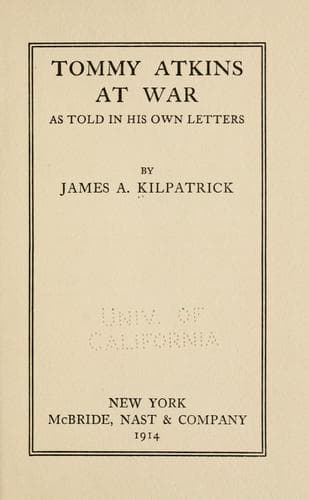
Tommy Atkins at War: As Told in His Own LettersKilpatrick, James Alexander
History
Tommy Atkins at War: As Told in His Own Letters
Kilpatrick, James Alexander
Great Britain. Army -- Military life; World War, 1914-1918
Francis Ryan, Northumberland Fusiliers, tells in the _Scotsman_ how
young lieutenant Smith-Dorrien pleaded to be allowed to remain with his
men in the trenches after a retirement had been ordered. The South
Staffordshires thought they were "getting along splendidly," says one of
the men, "until the General came and told us we must retreat or we would
be surrounded." The officer spoke very encouragingly, and praised his
men; but they were all so unwilling to yield ground that one of them,
expressing impatience, made a comment he would never have thought of
doing in peace time. The General only smiled.
This impatience pervaded all arms of the service. Some of the Highland
regiments began to grow grim and sullen, in spite of their play with the
bayonet; and the Irish corps became "unaisy." It was then that the
officers' fine spirit brought reassurance. This is how the King's Royal
Rifles were cheered up, according to Private Harman: "The officers knew
we were disappointed, because on the fifth day of retirement our
commanding officer came round and spoke to us. 'Stick it, boys, stick
it,' he said; 'To-morrow we shall go the other way and advance--Biff,
biff!' The way he said 'Biff, biff,' delighted the men, and after that
we frequently heard men shouting, 'Biff, biff!'"
General Sir John French, who is a great favorite with all ranks, and
spoken of with affection by every Tommy, makes frequent tours of the
lines and has a cheery word for every regiment. Driver W. Cryer, Royal
Field Artillery, relates in the _Manchester Guardian_ that, at St.
Quentin, Sir John French visited the troops, "smiling all over his
face," and explained the meaning of the repeated retirements. Up to
then, says Cryer, the men had almost to be pulled away by the officers,
but after the General's visit they fell in with the general scheme with
great cheerfulness.
Summing up his impressions of the nerve-strain of these weary rearguard
actions, a famous cavalry officer writing home, says: "We had a hell of
a time.... But the men were splendid. I don't believe any other troops
in the world could have stood it."
X
BROTHERS IN ARMS
There is a fine fraternity between the British and the French soldiers.
They don't understand very much of each other's speech, but they "muddle
through," as Atkins puts it, with "any old lingo." The French call out,
"Bravo, Tommee!" and share cigarettes with him: and Atkins, not very
sure of his new comrades' military Christian name, replies with a cheery
"Right, Oh!" Then turning to his own fellows he shouts, "Are we
downhearted?" and the clamorous "No!" always brings forth a rousing
French cheer.
Having seen each other in action since they first met on the way to
battle they have grown to respect each other more and more. There is not
much interchange of compliments in the letters from the trenches, but
such as there is clearly establishes the belief of Atkins that he is
fighting side by side with a brave and generous ally.
Public-domain text, read in full here on John Shaqi.
Reviews
Reviews
No reviews yet
Be the first to share your thoughts on this work.
Join the Discussion
Join the discussion
Sign in to leave a comment or review.
Sign InorCreate an account