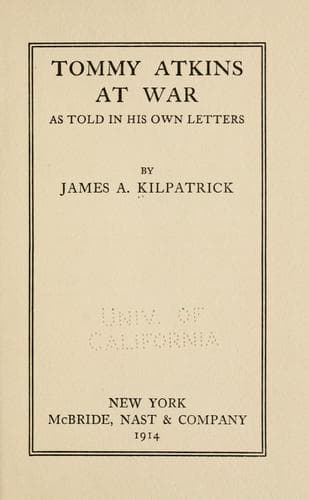
Tommy Atkins at War: As Told in His Own LettersKilpatrick, James Alexander
History
Tommy Atkins at War: As Told in His Own Letters
Kilpatrick, James Alexander
Great Britain. Army -- Military life; World War, 1914-1918
"We always knew," writes one soldier, "that the French were swift and
dangerous in attack, but we know now that they can fight on the
stubbornly defensive." One of the South Lancashires is loud in his
praise of their behavior under fire. "Especially the artillery,"
Sergeant J. Baker adds; "the French seem to like the noise, and aren't
happy unless it's there."
One of _The Times_ correspondents mentions that the German guns have a
heavy sound "boum," and the French a sharper one, "bing"; but neither of
them is very pleasant to the ear, and it requires a cultured military
taste like that of the French to enjoy the full harmony of the music
when the British "bang" is added to the general cannonading. The French
artillery is admitted to be fine, the deadly accuracy of the gunners
being highly praised by all who have watched the havoc wrought in the
German lines.
For the French soldier, however, the path of greatest glory lies in the
charge. Dash and fire are what he possesses in the highest degree. His
highly-strung temperament chafes under delays and disappointments. He
hasn't the solid, bull-dog courage that enables the British soldier to
take hard knocks, even severe punishment, and come up smiling again to
renew the battle that he will only allow to end in one way, and that
way victory.
In the advance, as one writer describes it, the French dash forward in
spasmodic movements, making immediately for cover. After a brief
breathing space they bound into the open again, and again seek any
available shelter. And so they proceed till the charge is sounded, when
with gleaming bayonets and a cry of "_pour la gloire_" upon their lips
they sweep down upon the enemy at a tremendous pace. The whole thing is
exhilarating to watch, and to the men engaged it is almost intoxicating.
They see red and the only thing that can stop them is the sheer dead
weight of the columns in front. To the French the exploit of the 9th
Lancers, already described in this volume, is the greatest thing in the
war. They would have died to have accomplished it themselves. The fine
heroics of such an exploit gives them a crazy delight. Then there are
the forlorn hopes, the bearing of messages across a zone of withering
fire, the fights for the colors. One incident which closely resembles
the exploit of the Royal Irish Fusiliers is recorded. A message had to
be borne to another regiment and volunteers sprang forward eagerly to
the call. The enemy's fire was particularly deadly at this point, and it
seemed impossible for a messenger to get through, but no man hesitated.
The first fell dead before he had traveled many yards, the second had a
leg shot off, the third by amazing luck got through without a scratch.
Deeds of this kind have endeared the French soldier to Tommy Atkins more
than all his extravagant acts of kindness, and the sympathetic bond of
valor has linked them together in the close companionship of
brothers-in-arms.
Public-domain text, read in full here on John Shaqi.
Reviews
Reviews
No reviews yet
Be the first to share your thoughts on this work.
Join the Discussion
Join the discussion
Sign in to leave a comment or review.
Sign InorCreate an account