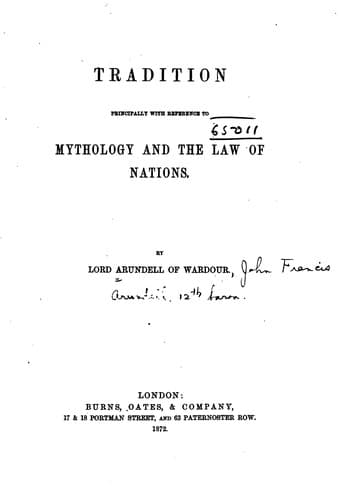
Tradition, Principally with Reference to Mythology and the Law of NationsArundell of Wardour, John Francis Arundell, Baron
Philosophy
Tradition, Principally with Reference to Mythology and the Law of Nations
Arundell of Wardour, John Francis Arundell, Baron
International law; Macdonell, George, 1780-1870; Mythology; Natural law; Tradition (Theology)
Colonel Macdonell was under the impression that he was unwittingly
and remotely the cause of the break up of the Ministry of "all the
talents." As this is an obscure point in history, it may be worth while
to give the following facts. The impression produced by Marengo and
Austerlitz had led to the Army Reform Bill of 1806, in which the points
discussed were almost identical with those which lately excited the
public mind. The disasters which accompanied our descent on Egypt in
1807, and the consequent evacuation of Alexandria, created considerable
discontent and re-opened the question, and as further reforms on minor
points were contemplated, suggestions from officers in the army were
invited.
Colonel Macdonell (then only lieutenant), wrote to Mr Windham, the
Secretary at War, to point out that any broken attorney might create
considerable embarrassment at any critical moment, seeing that, as
the law then stood (an Act of George I. had extended the obligation
of taking the sacrament to privates), any soldier could obtain, if
not his own, his comrade's discharge by pointing him out as a Papist.
The danger was recognised, and Mr Windham brought in a bill directed
to meet the case, but its introduction revived the larger question
of the repeal of the Tests' Acts and of the Catholic claims; and the
discussion eventuated in Lord Howick's bill, which was met by the
King's refusal, and the consequent resignation of the Ministry. This
may explain the statement (mentioned in the obituary notice in the
Times of the Marquis of Lansdowne), that he (Lord Lansdowne) could
never understand how the Ministry came to be dissolved. "He had heard
instances of men running their heads against a wall, but never of men
building up a wall against which to run their heads."[3]
[3] Sir H. Lytton Bulwer, in his "Life of Lord Palmerston," says,
i. p. 62, "There has seldom happened in this country so sudden
and unexpected a change of Ministers as that which took place
in March 1807."
It has been mentioned that Colonel Macdonell entered the army when
quite a boy; and there were few men, I fancy, living, when he died last
year, who could boast, as he could, of having served in the Duke of
York's campaign in the last century, but I am not able to state in what
regiment. He was for some time previously in Lord Darlington's regiment
of Fencibles. He was at one period in the 8th, and at another in the
50th regiment, in which latter, I think, he went out to the West Indies
and Canada.
It was in Canada, however, that his principal services were rendered,
which indeed were considerable, and have never been adequately
acknowledged.
When the Americans invaded Canada upon the declaration of war in
1812, it is hardly necessary to remind the reader that almost all our
available troops were engaged in the Peninsula, and that Canada was
pretty well left to its own resources.
Public-domain text, read in full here on John Shaqi.
Reviews
Reviews
No reviews yet
Be the first to share your thoughts on this work.
Join the Discussion
Join the discussion
Sign in to leave a comment or review.
Sign InorCreate an account