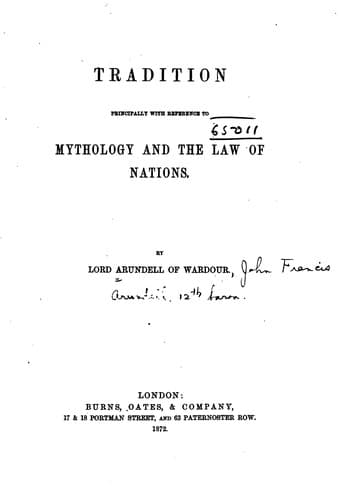
Tradition, Principally with Reference to Mythology and the Law of NationsArundell of Wardour, John Francis Arundell, Baron
Philosophy
Tradition, Principally with Reference to Mythology and the Law of Nations
Arundell of Wardour, John Francis Arundell, Baron
International law; Macdonell, George, 1780-1870; Mythology; Natural law; Tradition (Theology)
Colonel Macdonell's maternal uncle, Major Macdonald (Keppoch), was
taken prisoner at the battle of Falkirk. He was said to have been
the first man who drew blood in the war. By a curious revenue of
fortune, he was carried back into the enemy's ranks by the horse of
a trooper whom he had captured. He was executed at Carlisle, and the
circumstances of his execution supplied Sir Walter Scott, I believe,
with the incidents which he worked up into the narrative of MacIvor's
execution in "Waverley." His sword is in the possession of Mr P. Howard
of Corby Castle, near Carlisle.
Fortune, however, had in store another revenge; for the Duke of
Cumberland being present, many years afterwards, at a ball at Bath, by
a most unhappy selection indicated as the person with whom he wished to
dance a beautiful girl who turned out to be no other than the daughter
of Major Macdonald (afterwards married to Mr Chichester of Calverley)
the circumstances of whose execution have just been referred to. She
rose in deference to royalty, but replied, in a tone which utterly
discomfited, and put his Royal Highness to flight--"No, I will never
dance with the murderer of my father!"
With these antecedents, it is needless to add that Colonel G. Macdonell
was a warm admirer of the Stuarts, and not unnaturally extended his
sympathy and adhesion to the kindred cause of legitimacy in France;
and the one event to which he always looked forward, and confidently
predicted--the restoration of the monarchy in the person of Henri
V.--is now, if not imminent, at least "the more probable of possible
events." There was, however, a belief which somewhat conflicted in his
mind with the above anticipation--namely, his unshaken conviction that
the Dauphin did not die in the Temple. He was frequently at Holyrood
when the palace was occupied by Charles X., and he accompanied the
Duchess de Berri to the place of embarkation for her unfortunate
expedition to France. Colonel Macdonell also acted as the medium of
communication between the French Royalists and the English Government;
and on one important occasion conveyed intelligence to Lord Bathurst or
Lord Sidmouth respecting the movements of the secret societies in Spain
in 1823 some hours before it reached them by the ordinary channel.
Part of the communication was made on information supplied by the Abbé
Barruel; and in reply, Lord Sidmouth said--"Well, I remember Edmund
Burke telling me that he believed every word that Barruel had written,
and I fully accept the authority."
Public-domain text, read in full here on John Shaqi.
Reviews
Reviews
No reviews yet
Be the first to share your thoughts on this work.
Join the Discussion
Join the discussion
Sign in to leave a comment or review.
Sign InorCreate an account