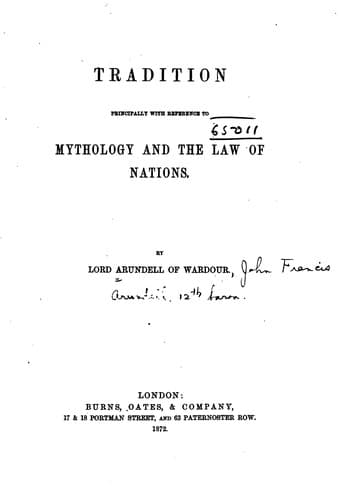
Tradition, Principally with Reference to Mythology and the Law of NationsArundell of Wardour, John Francis Arundell, Baron
Philosophy
Tradition, Principally with Reference to Mythology and the Law of Nations
Arundell of Wardour, John Francis Arundell, Baron
International law; Macdonell, George, 1780-1870; Mythology; Natural law; Tradition (Theology)
In truth, although Mr Bentham indulges a pleasant ridicule, yet the
ridicule and the thing ridiculed being eliminated, the fact that there
is a belief in a law of nature remains untouched. It is probable,
therefore, that appeals will be frequent to what is believed to be
"the eternal and immutable rule of right," "to the law of nature,"
&c., _i.e._ each and every individual, all mankind distributively, so
appeal, because there is a deep conviction among mankind, severally
and collectively, that there is this eternal and immutable rule of
right, blurred and obscured though it may be, or concealed behind a
cloud of human passion and error: and most men, moreover, will have an
instinct which will tell them when an individual is substituting his
own ideas for the eternal and immutable law,--as, for instance, when at
the conclusion of the sentence quoted, Mr Bentham seeks to substitute
his own peculiar crochet, as embodied in the word "utility" (which may
be used indifferently in the sense of the absolute or relative, the
supernatural or the natural, the immediate or the remote utility), as
synonymous with "natural justice," "natural equity," and "good order."
So, again, when Mr Bentham comes to the discussion of "International
Law," after pointing out, very properly, that whereas internal laws
have always a super-ordinate authority to enforce them, "that when
nations fall into disputes there is no such super-ordinate impartial
authority to bind them to conformity with any fixed rules," Mr Bentham
goes on to say, "though there is no distinct official authority capable
of enforcing right principles of international law, there is a power
bearing with more or less influence on the conduct of all nations, as
of all individuals, however transcendently potent they may be, this
is the power of public opinion." Public opinion! not then of public
opinion threatening coercion, for in that case we should have "a
super-ordinate impartial authority binding to conformity with fixed
rules," but public opinion as a moral expression. If, however, you take
from it the expression of right and wrong, of natural justice, and of
the eternal and immutable law; if its expression is not reprobation,
and, so to speak, a fore-judgment of the retribution of the Most High,
but only dissatisfaction or the mere pronouncement of the inutility
of the action, whatever it may be, what even with Benthamites can be
its efficacy and worth? The vanquished say to their conqueror, the
multitudes to their oppressor, this oppression is not according to
utility. Utility! he replies, useful to whom? To you! Fancy the look
of Prince Bismarck as he would reply to such an address. What are
men if you take away the notion of right and wrong but "the flies of
a summer?" How different was the expression of Napoleon after his
ill-usage of Pius VII., "J'ai frissonè les nations." Napoleon had a
conscience,[11] and in his moments of calm reflection felt in its full
force the reprobation of mankind.
Public-domain text, read in full here on John Shaqi.
Reviews
Reviews
No reviews yet
Be the first to share your thoughts on this work.
Join the Discussion
Join the discussion
Sign in to leave a comment or review.
Sign InorCreate an account