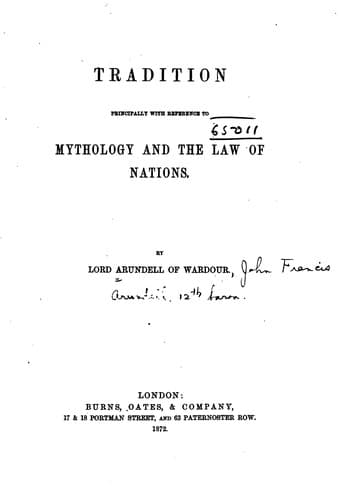
Tradition, Principally with Reference to Mythology and the Law of Nations — John Shaqi
Tradition, Principally with Reference to Mythology and the Law of NationsArundell of Wardour, John Francis Arundell, Baron
Philosophy
Tradition, Principally with Reference to Mythology and the Law of Nations
Arundell of Wardour, John Francis Arundell, Baron
International law; Macdonell, George, 1780-1870; Mythology; Natural law; Tradition (Theology)
[11] _Vide_ "Sentiment de Napoleon I. sur Le Christianisme,"
d'apres des temoignages recueillis par feu le Chevalier de
Beauterne. Nouvelle edition, par M. ----; Bray, Paris, 1860.
When Bentham, still speaking of public opinion, adds:--
"The power in question has, it is true, various degrees of
influence. The strong are better able to put it at defiance than
the weak. Countries which, being the most populous, are likely also
to be the strongest, carry a certain support of public opinion
with all their acts _whatever they may be_. But still it is the
only power which can be moved to good purposes in this case; and,
however high some may appear to be above it, there are in reality
none who are not more or less subject to its influence."
Here Bentham is again in imagination gathering men together like the
flies of a summer,--the force of their opinion depending on their
numbers. But what, again, is the force of all this buzzing if it is
the mere expression of "pleasure," or "pain," of satisfaction or
dissatisfaction in the masses? Conquerors may not always be relentless,
they may at times exhibit some sympathy with their fellow men; but as
a rule they are so dominated by some one idea or passion, or at best
are so absorbed in the interests of their own people, as to be deaf to
such appeals. Prince Bismarck's sentiments towards France during the
late war are pretty well known; but it is said that after the conflict
was over, and when France was in the throes of its terrible internecine
conflict, he was asked, "What is your Excellency's opinion of the
present state of France?" he replied, "Das ist mit ganz wurst," which
is equivalent to "I don't care two straws about it."[12] How are men
of this stamp to be affected by any exclamations of pleasure or pain?
If on the contrary it is the voice of reprobation which they hear, and
if in their case the saying "vox populi vox Dei" is felt to have its
full application, there is then a public opinion expressed which is
calculated to strike the conscience and inspire terror, and that is
quite another matter.
[12] _Neue Freie Presse_ of Vienna. _Pall Mall Gazette_, May 4,
1871.
De Tocqueville, from his own point of view, puts the argument in favour
of natural justice very forcibly, and in a certain construction would
express the identical truth for which I contend.
Public-domain text, read in full here on John Shaqi.
Reviews
Reviews
No reviews yet
Be the first to share your thoughts on this work.
Join the Discussion
Join the discussion
Sign in to leave a comment or review.
Sign InorCreate an account