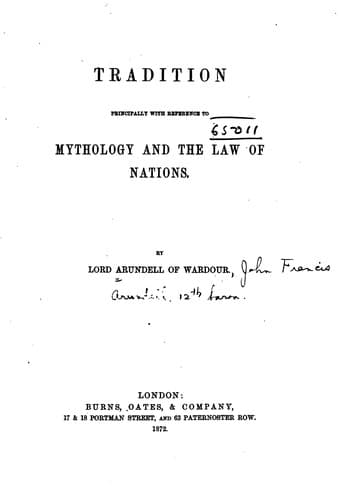
Tradition, Principally with Reference to Mythology and the Law of NationsArundell of Wardour, John Francis Arundell, Baron
Philosophy
Tradition, Principally with Reference to Mythology and the Law of Nations
Arundell of Wardour, John Francis Arundell, Baron
International law; Macdonell, George, 1780-1870; Mythology; Natural law; Tradition (Theology)
"I hold it to be an impious and an execrable maxim that,
politically speaking, a people has a right to do whatever it
pleases; and yet I have asserted that all authority originates in
the will of the majority. Am I, then, in contradiction with myself?
A general law which bears the name of Justice has been made and
sanctioned, not only by a majority of this or that people, but by
a majority of mankind. The rights of every people are consequently
confined within the limits of what is just. A nation may be
considered in the light of a jury which is empowered to represent
society at large, and to apply the great general law of justice.
Ought such a jury, which represents society, to have more power
than the society in which the laws it applies originate."--_M. de
Tocqueville's "Democracy in America_," ii. 151.
Although M. de Tocqueville's view does not go to the full length of
the argument, still, regarded in this light, the voice of the majority
of mankind, or of any large masses of mankind, has a very different
significance from what it bears in the writings of Bentham.
Let us now consider the doctrines of Bentham in their more recent
exposition.
The _Pall Mall Gazette_, Oct. 6, 1870, says:--
"Laws have been described as definitions of pre-existing rights,
relations between man and man, reflections of divine ordinances,
anything but what they really are,--forms of organised constraint.
It says little for the assumed clear-headedness of Englishmen, that
they have very generally preferred the ornate jargon of Hooker, to
the accurate and intelligible account of law and government which
forms the basis of Bentham's juridical system."
It says much, however, for their strong political sense and sagacity.
If this is the true and only description of law, it is tantamount to
saying that law is force and force is law; in other words, that the
commands of a legitimate government need not be regarded when it is
weak, but that the enactments of power must always be obeyed, however
it is acquired, and whether its decrees are in accordance with right
or contrary to justice. It is a ready justification for tyranny,
equally sanctioning the "lettres de cachet" of the ancient regime, and
the proscriptions of the Convention, equally at hand for the National
Assembly at Versailles, or for the Commune at Paris. But however much
it may be disguised, it is the only alternative definition of law, when
once you say that law is not of divine ordinance and tradition. If no
regard is to be had to the definition of right, but the term law is to
be applied to any adequate act of repression, there is in truth nothing
but force. Yet why should force adequate to its purpose seek to cloak
itself in the forms of law? I suppose the question must have been put
and answered before; but the answer can only be because law is felt to
import a totally different set of ideas from force.
Public-domain text, read in full here on John Shaqi.
Reviews
Reviews
No reviews yet
Be the first to share your thoughts on this work.
Join the Discussion
Join the discussion
Sign in to leave a comment or review.
Sign InorCreate an account