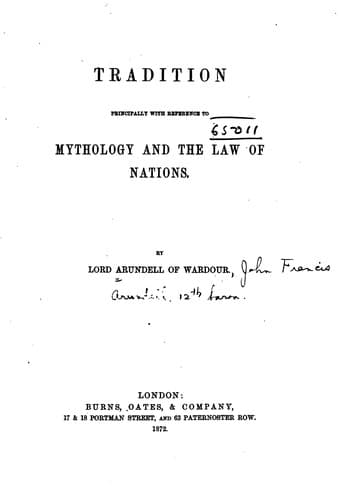
Tradition, Principally with Reference to Mythology and the Law of NationsArundell of Wardour, John Francis Arundell, Baron
Philosophy
Tradition, Principally with Reference to Mythology and the Law of Nations
Arundell of Wardour, John Francis Arundell, Baron
International law; Macdonell, George, 1780-1870; Mythology; Natural law; Tradition (Theology)
It is necessary, more especially now that the utilitarian theory is
dominant, to enter a protest according to the turn the argument may
take, but in the end nothing more can be said than was said by Cicero
in the century before our Lord:--
"Est enim unum jus, quo devincta est hominum societas, et quod lex
constituit una; quæ lex est recta ratio imperandi atque prohibendi:
quam qui ignorat is est injustus, sive est illa scripta uspiam,
sive nusquam. Quod si justitia est obtemperatio scriptis legibus
institutisque populorum, et si, ut iidem dicunt utilitate omnia
metienda sunt, negliget leges, easque perrumpit, si poterit, is,
qui sibi eam rem fructuosam putabit fore. Ita fit, ut nulla sit
omnino justitia; si neque naturâ est, eaque propter utilitatem
constituitur, utilitate alia convellitur."--_De Legibus_, i. 15.
It is only upon this construction that the Law of Nations can be said
to exist, as "there is no superordinate authority to enforce it." It
is accordingly asserted that the law of nations is not really law.
But is not this only when it is regarded from the point of view of
"organised constraint?"[13] If it is regarded as a divine ordinance,
or even as under the divine sanction, then it is law in a much higher
degree than simple internal or municipal law, for it more immediately
and directly depends upon this sanction; and hence nations may more
confidently appeal to heaven for the redress of wrong _here below_
than individuals--seeing that, as Bossuet somewhere says, God rewards
and chastises nations in this world, since it is not according to His
divine dispensation to reward them corporately in the next.
[13] "Utiles esse autem opiniones has quis neget, quum intelligat
quam multa firmentur jure jurando, quantæ salutis sint
f[oe]derum religiones? quam multos divini supplicii metus
a scelere revocaverit? quamque sancta sit societas civium
inter ipsos diis immortalibus interpositis tum judicibus tum
testibus?"--Cicero, _De Legibus_, ii. 7.
More recently, however, the extraordinary successes and subversions
which we have witnessed during this last year, have brought the _Pall
Mall Gazette_ face to face with problems pressing for immediate and
anxious settlement; and in a series of articles it has discussed the
question of the law of nations with much depth and earnestness.
I there observe phrases which I can hardly distinguish from those I
have just employed. Combating Mr Mill's view, the writer says:--
Public-domain text, read in full here on John Shaqi.
Reviews
Reviews
No reviews yet
Be the first to share your thoughts on this work.
Join the Discussion
Join the discussion
Sign in to leave a comment or review.
Sign InorCreate an account