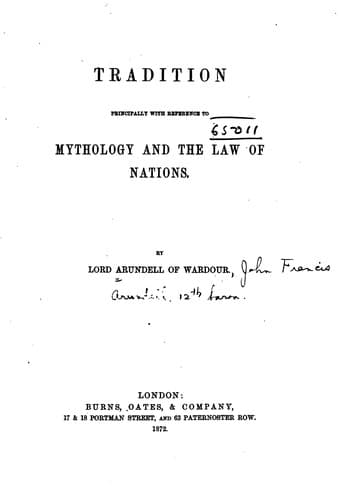
Tradition, Principally with Reference to Mythology and the Law of NationsArundell of Wardour, John Francis Arundell, Baron
Philosophy
Tradition, Principally with Reference to Mythology and the Law of Nations
Arundell of Wardour, John Francis Arundell, Baron
International law; Macdonell, George, 1780-1870; Mythology; Natural law; Tradition (Theology)
"Nobody knows better than he that International Law is not really
law, and why it is not law; but he seems to have jumped to the
conclusion that it is therefore the same thing as morality....
There cannot, in truth, be any closer analogy than that which
we drew the other day between the law of nations and the law of
honour, and between public war and private duelling." [This is
upon an assumption that there is nothing "essentially immoral
in the code of honour," as "to a great extent it coincided with
morality."] "But it differed from simple morality in that its
precepts were enforced, not by general disapprobation, but by
a challenge to the offender by anybody who supposed himself to
be aggrieved by the offence. The possible result always was,
that the champion of the law might himself be shot, and this was
the weakness of the system. But this is exactly the weakness of
international law, and the _original idea_ at the _basis_ both of
_public war_ and of private duelling was precisely the same,--_that
God Almighty somehow interposed_ in favour of the combatant _who
had the juster cause_. There is clear historical evidence that
the feuds which became duels were supposed to be fought out under
divine supervision, _just as battles_ were believed to be decided
by the God of battles."
I believe that if history could be re-written from this point of view
that many startling revelations would be brought to light. It is
with reluctance that I turn from the points upon which I approach to
agreement with the writer, to those upon which we fundamentally differ.
And here I must remark, that "the accurate and intelligible account
of law and government which forms the basis of Bentham's juridical
system"[14] (_supra_, p. 9), is not distinguishable from, and in any
case ultimately depends upon, his theory of utility as a foundation,
or, as his later disciples say, a "standard" of morals. Such a standard
is the negation of all morality; and if it ever came to stand alone
every notion of morals would be obliterated, because, being open to
every interpretation, and incapable of supplying any definite rule
itself, it would abrogate every other, and under a plausible form
abandon mankind to its lusts and passions.
[14] "From _utility_, then, we may denominate a principle that
may serve to preside over and govern, as it were, such
arrangements as shall be made of the several institutions, or
combinations of institutions, that compose the matter of this
science." Bentham's "Fragment on Government," xliii., and at
p. 45, the principle of utility is declared "all-sufficient,"
... that "principle which furnishes us with that reason, which
alone depends not upon any higher reason, but which is itself
the _sole and all-sufficient reason_ for _every point_ of
practice whatsoever."
Public-domain text, read in full here on John Shaqi.
Reviews
Reviews
No reviews yet
Be the first to share your thoughts on this work.
Join the Discussion
Join the discussion
Sign in to leave a comment or review.
Sign InorCreate an account