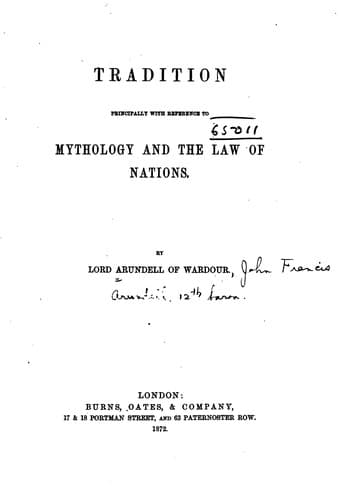
Tradition, Principally with Reference to Mythology and the Law of Nations — John Shaqi
Tradition, Principally with Reference to Mythology and the Law of NationsArundell of Wardour, John Francis Arundell, Baron
Philosophy
Tradition, Principally with Reference to Mythology and the Law of Nations
Arundell of Wardour, John Francis Arundell, Baron
International law; Macdonell, George, 1780-1870; Mythology; Natural law; Tradition (Theology)
In the _Pall Mall Gazette_, April 12, 1871, an article entitled
"Mr Darwin on Conscience," discusses Benthamism with reference to
Darwinism. There is a fitness in this which does not immediately appear.
The writer says:--
"What is called the question of the moral sense is really two:
how the moral faculty is acquired, and how it is regulated. Why
do we obey conscience or feel pain in disobeying it? And why does
conscience prescribe _one kind_ of actions and condemn another
kind? To put it more technically, there is the question of the
subjective existence of conscience, and there is the question of
its objective prescriptions."
I will avail myself of this distinction, and, setting aside the
questions referring to the "subjective existence of conscience," I
will ask attention only to "its objective prescriptions." Assuming,
then, the operations of conscience in the individual man, there will
necessarily also have been in the course of history some outward
expression of this inward feeling in maxims, precepts, and laws, if not
also reminiscences of primeval revelations and divine commands.
It will be true, therefore, to say, without touching the deeper
question of the foundation of morals, that there has been a tradition
of morals which cannot but have had its influence in all ages upon
the "social feelings" in which, according to the _Pall Mall Gazette_,
"it will always be necessary to lay the basis of conscience." Now
is this tradition of morals identical with utilitarian precept? If
the tradition of morals is identical with "the greatest happiness
principle," then that principle was no discovery of Bentham's,[15]
neither can Benthamism be regarded as "the new application of an old
principle." Bentham in that case simply informed mankind that they had
been talking prose all their lives without knowing it! Benthamism,
however, in point of fact, is felt as a new principle precisely in so
far as it discards the old morality. The question which I ask is, how
does it account for these old notions of morality obtaining among
mankind? How is it that mankind has so long and so persistently,
both in their notion of what was good and their sense of what was
evil, departed from the line of their true interests, as disclosed
in the utilitarian philosophy? If the history of man is what the
Scriptures tell us it was, the manner in which this has come about is
sufficiently explained; and there is no mystery as to the notion of
sin, the necessity of expiation, the restraints and limitations of
natural desires, the excellence of contemplation, and the obligation
of sacrifices and prayers. Now, if the history of mankind is not to be
invoked in explanation, it is difficult to see how these notions should
not conflict with any theory and plan of life based on a principle of
utility.[16] It is not unnatural, therefore, that the utilitarians
should turn to Darwinism and other such kindred systems for the
solution of their difficulties.
Public-domain text, read in full here on John Shaqi.
Reviews
Reviews
No reviews yet
Be the first to share your thoughts on this work.
Join the Discussion
Join the discussion
Sign in to leave a comment or review.
Sign InorCreate an account