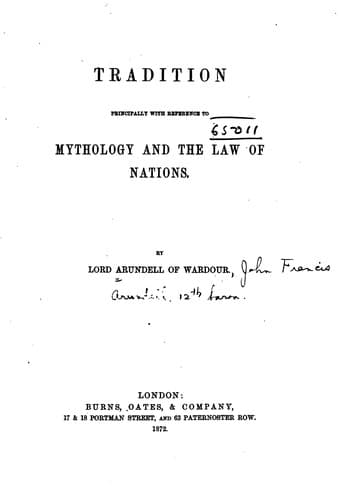
Tradition, Principally with Reference to Mythology and the Law of NationsArundell of Wardour, John Francis Arundell, Baron
Philosophy
Tradition, Principally with Reference to Mythology and the Law of Nations
Arundell of Wardour, John Francis Arundell, Baron
International law; Macdonell, George, 1780-1870; Mythology; Natural law; Tradition (Theology)
[15] Bentham speaks of his enunciation of "the greatest happiness
principle" in the following terms:--"Throughout the whole
horizon of morals and of politics, the consequences were
glorious and vast. It might be said without danger of
exaggeration, that they who sat in darkness had seen a great
light." With reference to this Lord Macaulay says, "We blamed
the utilitarians for claiming the credit of a discovery,
when they had merely stolen that morality (the morality of
the gospel) and spoiled it in the stealing. They have taken
the precept of Christ _and left the motive_, and they demand
the praise of a most wonderful and beneficial invention,
when all they have done has been to make a most useful maxim
useless _by separating it from its sanction. On religious
principles_ it is true that every individual will best promote
his own happiness by promoting the happiness of others. _But
if religious considerations be left out of the question it
is not true._ If we do not reason on the supposition of a
future state, where is the motive? If we do reason on that
supposition, where is the discovery?"--_Vide Lord Macaulay's
Essays on "Westminster Reviewer's Defence of Mill," and
"The Utilitarian Theory of Government" in Lord Macaulay's
"Miscellaneous Writings._"
[16] There was a way in which the argument was formerly stated
by utilitarians which was much more plausible, but which
I observe is now seldom if ever resorted to by the modern
exponents of this theory. The _Pall Mall Gazette_, April 12,
1871, says: "The now prevailing doctrine" that there is no
absolute standard of right and wrong, but "that the right and
wrong of an action or a motive depend upon the influence of
the action, or the motive upon the general good." The argument
to which I refer is thus stated by Mr W. O. Manning in his
"Commentaries on the Law of Nations," 1839:--"Everything
around us proves that God designed the happiness of His
creatures. It is the will of God that man should be happy.
To ascertain the will of God regarding any action, we have,
therefore, to consider the tendency of that action to promote
or diminish human happiness," p. 59. It is perfectly true
that man was created by God for happiness, and that ultimate
happiness, if he does not forfeit it, is the end to which
he is still destined. It is moreover true that even in this
world he may enjoy a conditional and comparative happiness.
How it is that this happiness cannot be complete and perfect
here below is precisely the secret which tradition reveals to
him. It is important, from the point of view of happiness,
both for individuals and nations, that the truth of this
Public-domain text, read in full here on John Shaqi.
Reviews
Reviews
No reviews yet
Be the first to share your thoughts on this work.
Join the Discussion
Join the discussion
Sign in to leave a comment or review.
Sign InorCreate an account