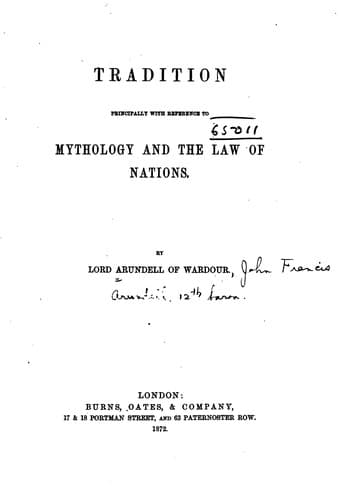
Tradition, Principally with Reference to Mythology and the Law of Nations — John Shaqi
Tradition, Principally with Reference to Mythology and the Law of NationsArundell of Wardour, John Francis Arundell, Baron
Philosophy
Tradition, Principally with Reference to Mythology and the Law of Nations
Arundell of Wardour, John Francis Arundell, Baron
International law; Macdonell, George, 1780-1870; Mythology; Natural law; Tradition (Theology)
revelation should be ascertained, and that the conditions
and limitations within which happiness is possible should
be known, otherwise life will be consumed in chimerical
pursuits of the unattainable, and in the case of nations will
be certain to end, at some time or another, in catastrophes
such as we have recently witnessed in Paris. In an enlarged
sense it is therefore true to say that the divine will has
regard to utility; but the view has this implied condition,
that what we regard as utility should in the first place be
conformable to what is directly or indirectly known to be the
divine precept and command; and, on the other hand, if no
advertence is made to revelation or the tradition of the human
race, what is called utility, however large and disinterested
the speculation may be, it can never be more than the view of
an individual or of a section of mankind, which it is highly
probable that other individuals and sections of mankind,
looking at the same facts, from a different point of view,
will see reason to contradict.
The _Pall Mall Gazette_, April 12, 1871, says:--
"Between Mr Darwin and utilitarians, as utilitarians, there is
no such quarrel as he would appear to suppose. The narrowest
utilitarian could say little more than Mr Darwin says (ii.
393):--'As all men desire their own happiness, praise or blame is
bestowed on actions and motives according as they tend to this end;
and as happiness is an essential part of the general good, the
greatest happiness principle indirectly serves as a nearly safe
standard of right and wrong.'"
Now, there is nothing in this reiteration of Benthamism which has not
been thrice refuted by Lord Macaulay in the Essays above referred to. I
append an extract more exactly to the point.[17]
Public-domain text, read in full here on John Shaqi.
Reviews
Reviews
No reviews yet
Be the first to share your thoughts on this work.
Join the Discussion
Join the discussion
Sign in to leave a comment or review.
Sign InorCreate an account