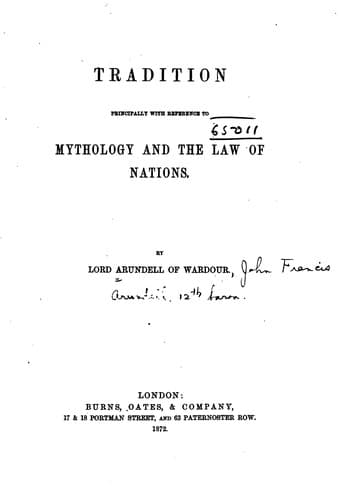
Tradition, Principally with Reference to Mythology and the Law of NationsArundell of Wardour, John Francis Arundell, Baron
Philosophy
Tradition, Principally with Reference to Mythology and the Law of Nations
Arundell of Wardour, John Francis Arundell, Baron
International law; Macdonell, George, 1780-1870; Mythology; Natural law; Tradition (Theology)
[17] If "the magnificent principle" is thus stated, "mankind ought
to pursue their greatest happiness," it must be borne in
mind that there are persons whose interests are opposed to
the greatest happiness of mankind. Lord Macaulay's opponent
replies, "ought is not predicable of such persons; for the
word ought has no meaning unless it be used in reference to
some interest." Lord Macaulay replied, "that interest was
synonymous with greatest happiness; and that, therefore,
IF the word _ought_ has no meaning unless used with
reference to interest, then, to say that mankind ought to
pursue their greatest happiness, is simply to say that the
greatest happiness is the greatest happiness; that every
individual pursues his own happiness; that either what he
thinks his happiness must coincide with the greatest happiness
of society or not; that if what he thinks his happiness
coincides with the greatest happiness of society, he will
attempt to promote the greatest happiness of society whether
he ever heard of the "greatest happiness principle" or not;
and that, by the admission of the Westminster Reviewer,
IF _his_ happiness _is inconsistent with_ the
greatest happiness of society, there is no reason why he
should promote the greatest happiness of society. Now, that
there are individuals who think _that_ for their happiness
which is not for the greatest happiness of society, is
evident.... The question is not whether men have _some_
motives for promoting the greatest happiness, but whether
the _stronger_ motives be those which impel them to promote
the greatest happiness."--_Lord Macaulay's "Miscellaneous
Writings," Utilitarian Theory of Government_, pp. 177-9.
I refer to it because it will be interesting to see how the argument
looks in its application to Darwinism.
It will be seen that if the conditions of unlimited enjoyment anywhere
existed, Lord Macaulay's strictures would lose something of their
force. If, indeed, there was superabundance and superfluity of
everything for all in this life, then anything which conduces to the
satisfaction of the individual would add to, or at least would not
detract from, the sum of happiness of all mankind. But unless you can
show this--if even the reverse of this is the truth--then "the greatest
happiness" will be in proportion to the self-abnegation of those who
possess more, or have the greatest faculties or facilities of producing
more.
Public-domain text, read in full here on John Shaqi.
Reviews
Reviews
No reviews yet
Be the first to share your thoughts on this work.
Join the Discussion
Join the discussion
Sign in to leave a comment or review.
Sign InorCreate an account