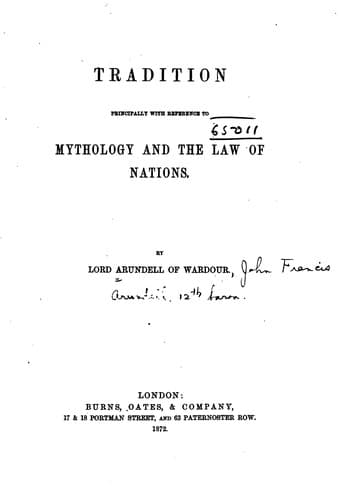
Tradition, Principally with Reference to Mythology and the Law of Nations — John Shaqi
Tradition, Principally with Reference to Mythology and the Law of NationsArundell of Wardour, John Francis Arundell, Baron
Philosophy
Tradition, Principally with Reference to Mythology and the Law of Nations
Arundell of Wardour, John Francis Arundell, Baron
International law; Macdonell, George, 1780-1870; Mythology; Natural law; Tradition (Theology)
Now, if there is one view more prominent than another in Mr Darwin's
work, it is embodied in the phrase to which he has given a new sense
and significance, "the struggle for existence." In the midst of this
struggle for existence, what is there in the greatest happiness
principle to bind the individual to abnegation? Why should he postpone
his certain and immediate gratification to the remote advantage of
others, or of distant and contingent advantage to himself? If, on
the other hand, he regards the transitoriness of the enjoyment, and
balances it against the fixity and eternity of the consequences, the
argument takes altogether different proportions, and the temptation to
enjoyment is inversely to the intensity of the struggle for existence.
I will take another test of Benthamism by Darwinism, which will
more exactly bring out the argument for which I contend. We have
a traditional horror of infanticide which revolts all our best
feelings and shocks our principles. But if Mr Darwin has demonstrated
this struggle for existence existing from all time; if also we are
disembarrassed from all advertence to another world; if, further,
Mr Malthus, before Mr Darwin, has shown reason to believe that
over-population is the cause of half the evils of this life, what is
there in Benthamite principles which should prevent our sacrificing
these unconscious innocents to the greatest happiness of the greatest
number? Nothing, except the horror we should excite among mankind still
imbued with the old superstitions! A person who did not hold to Mr
Malthus' views might demur; but a Malthusian, who was also a disciple
of Mr Bentham, could only hold back because his feelings were better
than his principles. A disciple of Mr Darwin's would probably stand
aloof, and would merely see in our notions an artificial interference
with the working of his theory, preventing the struggle for existence
going on according to natural laws. This seems to me to be almost said
in the same article from the _Pall Mall Gazette_, from which I have
quoted. Mr Darwin, in his "Origin of Species" (p. 249), has pointed out
that "we ought to admire the savage instinct which leads the queen-bee
to destroy her young daughters as soon as born, because this is for
the good of the community." And in his new book he says, firmly and
unmistakably (i. 73), that "if men were reared under precisely the
same conditions as hive-bees, there can hardly be a doubt that our
unmarried females would, like the worker-bees, think it a sacred duty
to kill their brothers, and mothers would strive to kill their fertile
daughters, and no one would think of interfering." The _Pall Mall_
continues--
Public-domain text, read in full here on John Shaqi.
Reviews
Reviews
No reviews yet
Be the first to share your thoughts on this work.
Join the Discussion
Join the discussion
Sign in to leave a comment or review.
Sign InorCreate an account