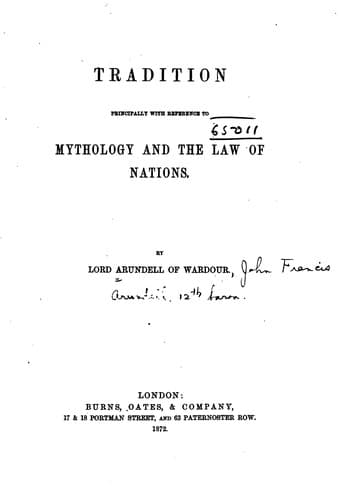
Tradition, Principally with Reference to Mythology and the Law of NationsArundell of Wardour, John Francis Arundell, Baron
Philosophy
Tradition, Principally with Reference to Mythology and the Law of Nations
Arundell of Wardour, John Francis Arundell, Baron
International law; Macdonell, George, 1780-1870; Mythology; Natural law; Tradition (Theology)
The nineteenth century is now verging on its decline, and of it, too,
may we say that it has been better than its principles. Yet, in spite
of its philanthropy, and its aspirations for good, the destructive
principles which it has nursed are rapidly gaining on its instincts:
and if we may not truly at this moment paint its glories, as they have
been depicted, I think by Alexandre Dumas, as "the livery of heroism,
turned up with assassination and incest," is the time very remote when
the description will apply?
CHAPTER II.
_THE LAW OF NATURE._
But underlying the question of the law of nations, and determining it,
is the question whether or not there is a law of nature--a rule of
right and wrong, independent of, and anterior to, positive legislative
or international enactment. To prevent misconception, however, as
to the scope of the inquiry, it is as well that I should state that
I am only regarding the law of nature as the law of conscience (by
which the Gentiles "were a law unto themselves," Rom. ii. 14), in so
far as it has manifested itself in laws and maxims; and the question
I am here concerned with is, whether in any sense which history can
take cognizance of, there was a rule of right and wrong previous to
legislative enactment?
At the first glance, the question would seem sufficiently disposed
of by saying that men never were in a state of nature; which is true
in this sense, that mankind never formed a multitude of isolated
individuals, or a promiscuous herd of men and women. A totally
different solution supposes a state of nature; but which, whether it
depicts it as a golden age or an age of barbarism, still contemplates
mankind in this state as a mere congeries of individuals, without law,
or else without the necessity of law--in either case an aggregate of
isolated individuals, eventually to be brought into the state of civil
society by a social compact.
Now my intention is not to combat this view--which at the present
moment may be considered to be exploded--but to account for it.
I think that I shall do something towards clearing up this mystery by
pointing out that this latter solution, although in great vogue with
the publicists of the seventeenth and eighteenth centuries, is traced
beyond them to the classical times, and was derived by them through the
tradition of the Roman law from Paganism. A theory of the lawyers, and
a theory of the philosophers, concreted with a true but distorted fact
in tradition in order to produce this belief, viz., that society was
founded by a contract among men who were originally equal.[18]
[18] It will be seen, later on, in what this view differs from Sir
Henry Maine's.
Public-domain text, read in full here on John Shaqi.
Reviews
Reviews
No reviews yet
Be the first to share your thoughts on this work.
Join the Discussion
Join the discussion
Sign in to leave a comment or review.
Sign InorCreate an account