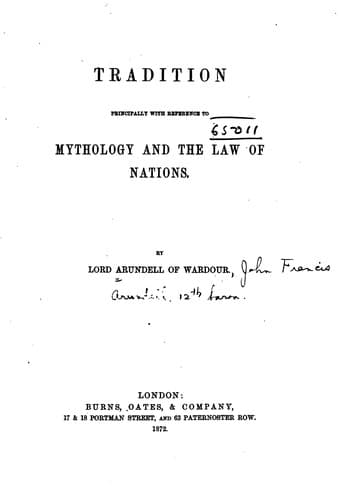
Tradition, Principally with Reference to Mythology and the Law of Nations — John Shaqi
Tradition, Principally with Reference to Mythology and the Law of NationsArundell of Wardour, John Francis Arundell, Baron
Philosophy
Tradition, Principally with Reference to Mythology and the Law of Nations
Arundell of Wardour, John Francis Arundell, Baron
International law; Macdonell, George, 1780-1870; Mythology; Natural law; Tradition (Theology)
I shall in a subsequent chapter state to what extent I believe it to
be true that society was founded upon a contract, and also the way in
which this impression was confirmed, from the actual circumstances
of the formation of the early communities of Greece and Italy; and I
shall then examine the true tradition, such as I believe it to be, of
a state of nature associated with the reminiscence of a golden age,
as contrasted with the distinct yet parallel tradition of a state of
nature identified with a state of barbarism (_vide_ ch. vii. and ch.
xiii.)
This latter tradition I believe to have been a recollection of that
period of temporary privation after the Flood, when mankind clung to
the caverns and the mountains (_vide_ p. 137), until, incited by
the example of Noah, they were brought into the plains, and instructed
in the arts of husbandry by the patriarch; and the notion of the
primitive equality[19] of condition I believe to have originated in
the Bacchanalian traditions of the same patriarch.[20]
[19] In all the Diluvian commemorative festivals, to which I shall
draw attention (ch. xi.), there is one day set apart for the
commemoration of this primitive equality, accompanied with
Bacchanalian festivities and ceremonials.
[20] Sir H. Maine ("Ancient Law," p. 95) says, "Like all other
deductions from the hypothesis of a law natural, and like the
belief itself in a law of nature, it was languidly assented
to, until it passed out of the possession of the lawyers into
that of the literary men of the eighteenth century, and the
public which sat at their feet. With them it became the most
distinct tenet of their creed, and was even regarded as the
summary of all the others."
If we start with a belief in the primitive equality of conditions, the
only way out of the mesh is apparently by a theory of a compact.
"From the Roman law downwards," says Sir G. C. Lewis, "there has
been a strong tendency among jurists to deduce recognised rights
and obligations from a supposed, but non-existing contract. When
an express contract exists, the legal rights and duties which it
creates are in general distinct and well-defined. Hence, in cases
where it is wished that similar legal consequences should be drawn,
which come within the spirit of the rules applicable to a contract,
though they do not themselves involve any contract, the lawyer cuts
the knot by saying that a contract is presumed, that there is a
contract by intendment of law, that there are certain rights and
obligations "_quasi ex contractu_." Thus the Roman law held that a
guardian was bound to his ward by a _quasi_ contract."--_Sir G. C.
Lewis, "On the Methods of Observation, &c., in Politics_," i. 423;
"_On the Social Compact_," pp. 424-431.
Public-domain text, read in full here on John Shaqi.
Reviews
Reviews
No reviews yet
Be the first to share your thoughts on this work.
Join the Discussion
Join the discussion
Sign in to leave a comment or review.
Sign InorCreate an account