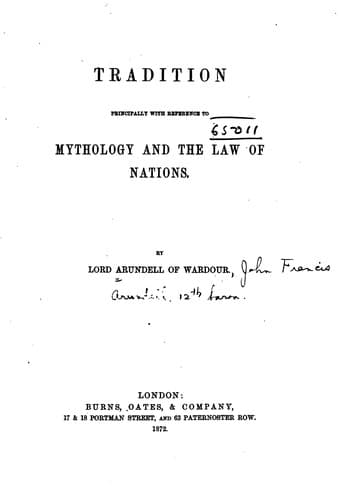
Tradition, Principally with Reference to Mythology and the Law of NationsArundell of Wardour, John Francis Arundell, Baron
Philosophy
Tradition, Principally with Reference to Mythology and the Law of Nations
Arundell of Wardour, John Francis Arundell, Baron
International law; Macdonell, George, 1780-1870; Mythology; Natural law; Tradition (Theology)
It is not difficult to see how such a fiction of the law would tend to
give shape and system to the vague tradition as to the fact among the
populace.
The way in which the philosopher came to his conclusion was somewhat
more complex. It will have been seen that the notion of the state of
nature and the social compact was, among the ancients, in the main, a
figment of the imagination, and not a tradition. But there was also
a tradition of a law of nature which did not at all correspond to a
state of license, of equality, and of barbarism, such as the state of
nature was conceived to be. It was, on the contrary, a law of decorum
and restraint. What, then, the Roman probably meant by the law of
nature was a reminiscence of a primitive revelation, or a tradition
of the maxims of right and wrong by which men were guided in their
relations to one another, when fresh from the hand of God--"_a diis
recentes_"--when family life still subsisted, and before men had
settled down into states and communities. It was not a law of nature
as nature then was, but an aspiration after a lost rule of life, as
after a higher standard, and an attempt to trace it back, through the
corruption of mankind. Dim and uncertain as these notions were, they
were not without their influence.
But their ideas as to the cosmogony were more shadowy still. When,
then, in reasoning from a law of nature to a state of nature, mankind
discovered that they knew or remembered nothing of their origin, or
of the history of the human race, except indirectly through legendary
lore, they then had recourse to the philosophers. These latter then
did what philosophers incline to do in such cases of difficulty. They
regarded the existing state of things, and finding it to be artificial,
they, by a process of abstraction, resolved it into its elements,
and, having thus reduced society into an assemblage of individuals,
substituted their last analysis for the commencement of all things. In
this analysis they found men, what historically and in fact they had
never been, alike free, equal, and independent.
Public-domain text, read in full here on John Shaqi.
Reviews
Reviews
No reviews yet
Be the first to share your thoughts on this work.
Join the Discussion
Join the discussion
Sign in to leave a comment or review.
Sign InorCreate an account