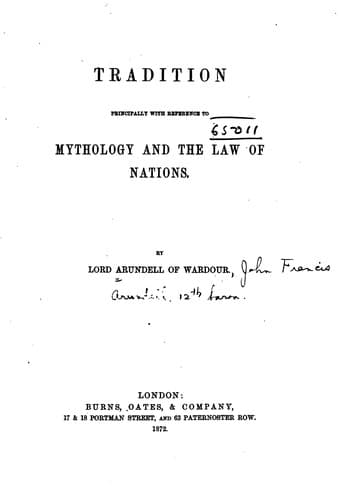
Tradition, Principally with Reference to Mythology and the Law of NationsArundell of Wardour, John Francis Arundell, Baron
Philosophy
Tradition, Principally with Reference to Mythology and the Law of Nations
Arundell of Wardour, John Francis Arundell, Baron
International law; Macdonell, George, 1780-1870; Mythology; Natural law; Tradition (Theology)
The theory of the social compact among men individually free and
equal was in the main a fiction, started _à posteriori_ to account
for relations otherwise obscure, or, as Sir Henry Maine explains,
to facilitate modifications which were felt to be desirable; and we
cannot be astonished that Paganism should take this view, unless we are
prepared to believe that the traditions truly embodying the history
of the world were more direct, vivid, and potential than I suppose
them to have been. It is at least remarkable, that in proportion as
men lose their faith, they fall back, as if by some necessary law,
upon some theory which directly or indirectly contemplates mankind
as a collection of atoms; and if ever society should lose again the
history of its origin, as would happen if ever infidelity were to gain
complete ascendancy, it would return by the same processes to the
same conclusion. But however sceptical individual minds may become,
or however general may be the disposition to reject or ignore the
scriptural narrative, the general framework of its statements is now
too firmly embedded in the belief of mankind to be easily overthrown.
The notion of a social compact, in more recent times, obtained a
certain credence[21] so long as the discussion was confined to Hobbes,
Locke, and their disciples. And it must be borne in mind that this
is a very taking theory, a ready and convenient starting point, and
conformable to much that is true in history and politics. But it is
long since exploded; and even the fervid advocacy of Rousseau, in an
age peculiarly predisposed for its reception, could not secure for it
even temporary recognition among mankind; and why? Because, whenever
the discussion cools, men will inevitably ask each other the question,
If such a compact took place, where shall we locate it consistently
with the evidence recorded in Genesis? Remove the evidence in Genesis,
and such a theory becomes at once a tenable and plausible conjecture.
[21] "The earlier advocates of the doctrine of the social compact
maintained it on the ground of its _actual existence_.
They asserted that this account of the origin of political
societies was _historically true_. Thus Locke, &c."--_Sir G.
C. Lewis, "Meth. of Reasoning in Pol._" i. p. 429.
Public-domain text, read in full here on John Shaqi.
Reviews
Reviews
No reviews yet
Be the first to share your thoughts on this work.
Join the Discussion
Join the discussion
Sign in to leave a comment or review.
Sign InorCreate an account