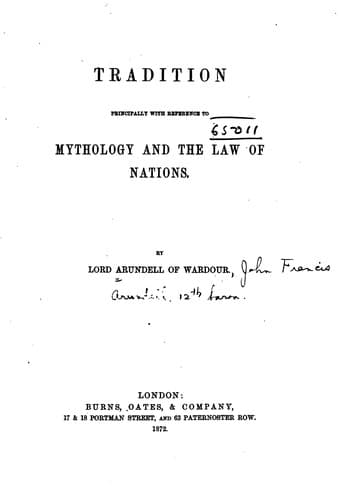
Tradition, Principally with Reference to Mythology and the Law of Nations — John Shaqi
Tradition, Principally with Reference to Mythology and the Law of NationsArundell of Wardour, John Francis Arundell, Baron
Philosophy
Tradition, Principally with Reference to Mythology and the Law of Nations
Arundell of Wardour, John Francis Arundell, Baron
International law; Macdonell, George, 1780-1870; Mythology; Natural law; Tradition (Theology)
As I shall have occasion, later on, to come into collision with Sir
Henry Maine upon some points, I have the greater satisfaction here in
invoking his testimony. This acute and learned writer ("Ancient Law,"
p. 90) regrets that the Voltairean prejudices of the last century
prevented reference "to the only primitive records worth studying--the
early history of the Jews[22].... One of the few characteristics which
the school of Rousseau had in common with the school of Voltaire was an
utter disdain of all religious antiquities, and more than all of those
of the Hebrew race. It is well known that it was a point of honour with
the reasoners of that day to assume, not merely that the institutions
called after Moses were not divinely dictated, ... but that they
and the entire Pentateuch were a gratuitous forgery executed after
the return from the Captivity. Debarred, therefore, from one chief
security against speculative delusion, the philosophers of France, in
their eagerness to escape from what they deemed a superstition of the
priests, flung themselves headlong into a superstition of the lawyers."
[22] "The only reliable materials which we possess, besides the
Pentateuch, for the history of the period which it embraces,
consist of some fragments of Berosus and Manetho, an epitome
of the early Egyptian history of the latter, a certain number
of Egyptian and Babylonian inscriptions, and two or three
valuable papyri."--_Rawlinson, Bampton Lectures._ Oxford,
1859, ii. 55.
CHAPTER III.
_PRIMITIVE LIFE._
The scriptural narrative seems to establish:--(1.) That human society
did not commence with the fortuitous concurrence of individuals, but
that, though originating with a single pair, for the purposes of
practical inquiry it commences with a group of families--the family of
Noah and his sons, together with their families, and whose dispersion
in other families is subsequently recorded. (2.) That men were not
primitively in a state of savagery, barbarism, and ignorance of civil
life; but that, on the contrary, it is presumable that Noah and his
family brought with them out of the ark the traditions and experiences
of two thousand years, and, not to speak of special revelations, the
arts of civil life and acquaintance with cities. (3.) That, although
everything in the early state of mankind would have led to dispersion,
and although there is mention of one great and complete dispersion,
yet this dispersion of mankind was a dispersion of families and not of
individuals.
In all our speculations, therefore, as to society and government, it is
the family and not the individual whom we must regard as the elementary
constituent.
Public-domain text, read in full here on John Shaqi.
Reviews
Reviews
No reviews yet
Be the first to share your thoughts on this work.
Join the Discussion
Join the discussion
Sign in to leave a comment or review.
Sign InorCreate an account