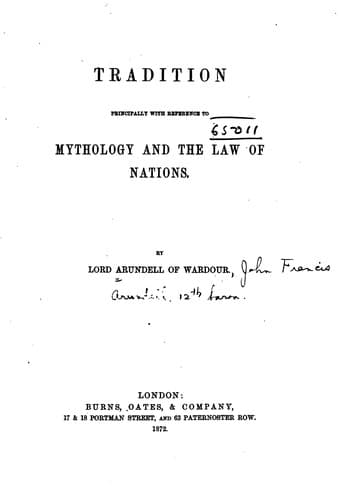
Tradition, Principally with Reference to Mythology and the Law of NationsArundell of Wardour, John Francis Arundell, Baron
Philosophy
Tradition, Principally with Reference to Mythology and the Law of Nations
Arundell of Wardour, John Francis Arundell, Baron
International law; Macdonell, George, 1780-1870; Mythology; Natural law; Tradition (Theology)
Moreover, so long as family government sufficed, there was nothing but
the family. The state would have existed only in germ (_vide infra_,
p. 341), and would have remained thus inchoate even during that
subsequent period when families were affiliated in tribal connection,
though not yet coalesced into tribal union. It is my impression, that
the period during which family government sufficed, continued much
longer than is generally supposed; for, until the world became peopled
and crowded, everything led to dispersion and the continuance of the
pastoral state of life. From the necessities of pastoral life, mankind
in early times could not have been gregarious--herds would have become
intermixed, keep would have become short, the broad plains were spread
out before them;[23] _e.g._ Gen. chap. xiii.--
"But Lot also, who was with Abraham, had flocks of sheep, and herds
and tents. 6. Neither was the land able to bear them, that they
might dwell together. 7. Whereupon there arose a strife between the
herdsmen of Abraham and Lot; and at that time the Canaanite and the
Perizzite dwelt in that country. 8. Abraham therefore said, Let
there be no quarrel. 9. Behold the whole land is before thee."[24]
[23] I indicated this view in a pamphlet, "Inviolability of
Property by the State, by an English Landlord." 1866.
[24] Again Esau and Jacob separated, after the death of the
patriarch Isaac, because their stock in herds and flocks had
so increased that, according to the scriptural phrase, "it
was more than they might dwell together," and further, "the
land would not bear them because of their cattle."--Gen. chap,
xxxvi.; _Vide_ "Pinkerton, Voy." i. 528.
Writing with reference to the Hamitic dynasty, founded at
Babylon by Nimrod (_vide_ Rawlinson, Anc. Mon.), and the
conquests of Kudur-Lagamer, identified by Rawlinson as
Chedor-Laomer, Mr Brace adds ("Ethnology," p. 28):--"This
at a period, as Professor Rawlinson remarks, when the kings
of Egypt had never ventured beyond their borders, and when
no monarch in Asia held dominion over more than a few petty
tribes and a few hundred miles of territory."--_Vide_ ch.
xiii. "A Golden Age."
Public-domain text, read in full here on John Shaqi.
Reviews
Reviews
No reviews yet
Be the first to share your thoughts on this work.
Join the Discussion
Join the discussion
Sign in to leave a comment or review.
Sign InorCreate an account