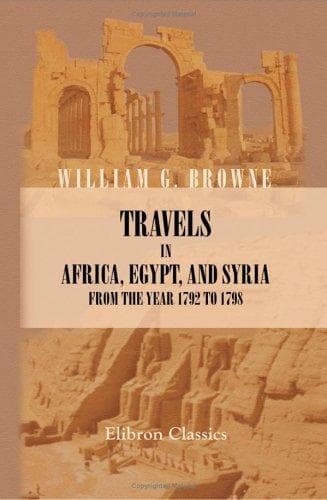
Travels in Africa, Egypt, and Syria, from the year 1792 to 1798Browne, William George
History
Travels in Africa, Egypt, and Syria, from the year 1792 to 1798
Browne, William George
Egypt -- Description and travel; Sudan -- Description and travel; Syria -- Description and travel
I therefore, by means of my interpreter, whom I had always found
honest in his report, and attentive to my wishes, collected three
of the Shechs who had shewn themselves most friendly to us, with my
conductor, and two other Arabs who happened to be there. They entered
freely into conversation about the roads, and described what was known
to them of Elwah, Fezzan, and other places. But in the direction
laid down for the site of the temple, they declared themselves
ignorant of any such remains. I inquired for a place of the name of
_Santrieh_, but of this too they professed their ignorance. Then,
said I, if you know of no place by the name I have mentioned, and of
no ruins in the direction or at the distance described, do you know
of no ruins whatever farther to the westward or south-west? Yes,
said one of them, there is a place called _Araschié_, where are
ruins, but you cannot go to them, for it is surrounded by water,
and there are no boats. He then entered into an enchanted history
of this place; and concluded with dissuading me from going there. I
soon found, from the description, that _Araschié_ was not the Oasis
of Ammon, but conceiving it something gained to pass farther west,
and that possibly some object might eventually offer itself that
would lead to farther discovery, I determined, if it were possible,
to proceed thither.
For this purpose we were obliged to use all possible secrecy, as the
Siwese were bent on opposing our farther progress. An agreement was
therefore made with two persons of the poorer class of the natives,
for a few zecchins, that they should conduct us to _Araschié_;
and if what we sought for was not there found, that they should,
on leaving it, proceed with us to the first watering-place that
they knew directly to the southward. The remainder of the time I
stayed at Siwa was employed in combating the difficulties that were
raised about our departure; and it was not till Monday, 12th March,
that we were enabled to commence our journey west.
The Oasis which contains the town Siwa, is about six miles long,
and four and a half or five wide. A large proportion of this space
is filled with date trees; but there are also pomegranates, figs,
and olives, apricots and plantains; and the gardens are remarkable
flourishing. They cultivate a considerable quantity of rice,
which, however, is of a reddish hue, and different from that of
the Delta. The remainder of the cultivable land furnishes wheat
enough for the consumption of the inhabitants. Water, both salt
and fresh, abounds; but the springs which furnish the latter are
most of them tepid; and such is the nature of the water, air, and
other circumstances, that strangers are often affected with agues
and malignant fevers. One of those springs, which rises near the
building described, is observed by the natives to be sometimes cold
and sometimes warm.
Public-domain text, read in full here on John Shaqi.
Reviews
Reviews
No reviews yet
Be the first to share your thoughts on this work.
Join the Discussion
Join the discussion
Sign in to leave a comment or review.
Sign InorCreate an account