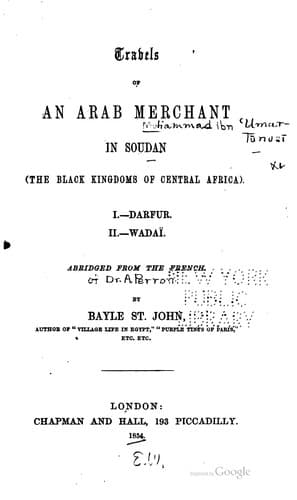
Travels of an Arab merchant in Soudan (the Black Kingdoms of Central Africa)Tūnisī, Muḥammad ibn ʻUmar
History
Travels of an Arab merchant in Soudan (the Black Kingdoms of Central Africa)
Tūnisī, Muḥammad ibn ʻUmar
Darfur (Sudan) -- Description and travel; Wadai (Sultanate) -- Description and travel
If the Sultan was severe towards criminals, he was remarkable for
his benevolence for Ulemas and Shereefs, and other learned men,
who came flocking to visit him from all sides. Among these was my
father, who, when he arrived in Darfur, had gone to live at Kobeih,
in the house of a sheikh. Many of the principal learned men of the
country came here to visit him, and beg him to explain the book
of the Sheikh Khalil on Muslim canon law, which he did. The news
of his learning came to the ears of the Sultan, who called him to
his court, and lodged him in the house of one of his sons-in-law,
named Nour-el-Ansary. This man was a Fakih, and loved knowledge. He
studied with my father, and spoke of his learning to the Sultan,
who read on scientific subjects with my father during the month of
Ramadhan. He also requested my father to comment for him the book on
the privileges accorded by God to the Prophet, by a Turkish writer,
and he produced a commentary, called “The Perfect Pearl,”
which he afterwards followed by another work of the same nature,
called “The Equal Pearls.”
Abd-er-Rahman was likewise generous, as well as just and pure in
manners. He was of middle size, of a dark black complexion, with a
beard speckled with white, and a coarse and deep voice. He easily
became angry, but he calmed promptly, and pardoned easily. He was
possessed of presence of mind and tact, of which I shall give
some examples. When the French came to Cairo, and the Mamlouks
were driven away, one of the Kashefs, named Zawanah, fled to
Darfur, along with about ten other Mamlouks. He had with him also
considerable property, with camels, servants, a cook, a valet, and
several grooms; he had also with him a cannon and a howitzer. Upon
his arrival, he was well received by Abd-er-Rahman, who gave him a
dwelling-place, and assigned to him a revenue, and bestowed upon him
numerous female slaves. After a little while he begged permission
to build a house, like those of Cairo; and, having caused bricks
to be baked, got together a number of workmen, chosen among the
black slaves, to cut stones, and constructed a habitation of some
grandeur. He surrounded it by a wall of extraordinary solidity,
with two embrasures turned towards the palace, which this little
fortress completely commanded. The fact was, that this Ghouz had
formed the mad plan of killing Abd-er-Rahman, and seizing on the
government of Darfur. His idea was, that some day, when the Sultan
came out with his courtiers, he would fire a volley of grape-shot
among them, and thus clear the way to the throne.
Public-domain text, read in full here on John Shaqi.
Reviews
Reviews
No reviews yet
Be the first to share your thoughts on this work.
Join the Discussion
Join the discussion
Sign in to leave a comment or review.
Sign InorCreate an account