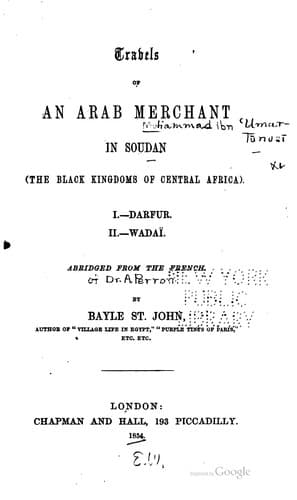
Travels of an Arab merchant in Soudan (the Black Kingdoms of Central Africa)Tūnisī, Muḥammad ibn ʻUmar
History
Travels of an Arab merchant in Soudan (the Black Kingdoms of Central Africa)
Tūnisī, Muḥammad ibn ʻUmar
Darfur (Sudan) -- Description and travel; Wadai (Sultanate) -- Description and travel
Darfur, or, more properly, Dar-el-fur, the country of Fur, is the
third kingdom of Soudan, counting from east to west. The first
is Sennaar; the second Kordofal; the fourth is Wadaï; the fifth
Bagirmeh; the sixth Bornou; the seventh Adagez;[13] the eighth Afnou;
the ninth Timbuktou; the tenth Dar-Mella, where resides the King
of the Fullan, or Fellatahs.
Formerly, the name of Takrour was applied only to the inhabitants of
Bornou, but it is now extended to all the people who live between
the eastern limit of Wadaï and the western limit of Bornou; so
that it includes, besides these two countries, Bagirmeh, Katakou,
and Mandarah. Some days ago I met, at Cairo, an individual whom I
recognised as a Soudanee. I asked him to what country he belonged. He
replied, “I am a Takrour.” “But from what place?” said
I. After some difficulty, he replied that he was from Bagirmeh.
Darfur is bounded on the east by a sandy and nearly sterile country,
and the same description applies to the provinces situated between
it and Wadaï. Southward are vast plains, stretching to Dar-fertit,
and to the north is the desert, which I have described on my way
from Egypt. The country, which is forty days in length from north
to south, and eighteen days’ breadth, is divided into numerous
provinces, each under the authority of a governor. Some of these
governors bear the title of Sultan, but they are all dependent on
the Sultan of Darfur. Their mode of life is very similar, and their
costume is uniform, except in the case of the Tunjour, who wear a
black turban. I asked one of them the reason. He told me that his
ancestors had formerly been sovereigns of the whole country, but
had been dispossessed by the Forians, and that, since that time,
they had worn the black turban as a sign of mourning.
On the east and south, Darfur is surrounded by tribes of wandering
Arabs, whose wealth consists in cattle, horses, and furniture. They
lead a nomadic life, going from pasturage to pasturage. Some of them
possess great herds of camels. The Sultan of Darfur claims from them
an annual impost, which they sometimes refuse. The Red Masirieh
and the Rezeigat, being the most powerful and most distant in the
desert, only give the refuse of their flocks. The agent who is sent
to collect the tribute is sometimes beaten and killed. Attempts
have been made to punish them by force, but they are generally
repulsed with loss. The Arabs retire, if too hotly attacked, with
their flocks into the Barajoub, a country situated to the south-east
of Darfur. It is a vast marsh, ten days’ journey in extent, but
covered with thick forest. Rain is said to fall there all the year
round, except during two months.
Public-domain text, read in full here on John Shaqi.
Reviews
Reviews
No reviews yet
Be the first to share your thoughts on this work.
Join the Discussion
Join the discussion
Sign in to leave a comment or review.
Sign InorCreate an account