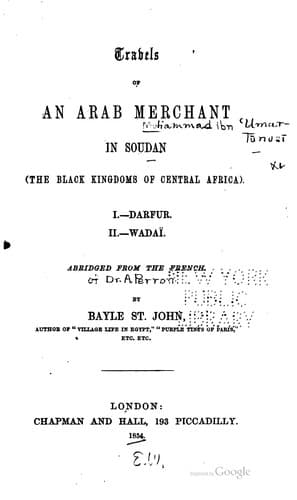
Travels of an Arab merchant in Soudan (the Black Kingdoms of Central Africa)Tūnisī, Muḥammad ibn ʻUmar
History
Travels of an Arab merchant in Soudan (the Black Kingdoms of Central Africa)
Tūnisī, Muḥammad ibn ʻUmar
Darfur (Sudan) -- Description and travel; Wadai (Sultanate) -- Description and travel
The whole country of Darfur, on both sides of the chain of mountains,
and north and south, is inhabited by a variety of tribes which
do not belong, properly speaking, to the Forian race. The latter,
who speak a language apart, occupy the range of mountains, but have
conquered the whole surrounding country. There are in the country
also a number of people of mixed race, children of strangers.
The districts on the northern frontier are the most fully
populated. They are called Zaghawah and Berti, and exhibit a
remarkable contrast; the people of the latter being gentle and good,
and of agreeable physiognomy, with women of remarkable beauty,
whilst the people of the latter are different from them in every
respect. The corresponding districts, at the southern extremity,
are Dajo and Bijo, and the women of the latter are also more
beautiful than the women of the former. The people of Birguid and
of Tunjour, who occupy the middle provinces, are not contrasted by
personal appearance, but by character; the former being treacherous,
dishonest, and rapacious, without fear of God or the Prophet, whilst
the latter have a certain amount of religion and intelligence. The
mountaineers of Marrah are all savage and brutal in the same degree,
except that at Dar-Abbima, towards the south, both men and women are
more affable and of more agreeable aspect. Glory be to the Creator,
who has permitted these striking contrasts! At Dar-el-Massalit
the beauty of the women is ravishing, silencing the reason and
captivating the heart. Nevertheless, the most beautiful women who
are found in Darfur are, without exception, those of Arab descent;
and the same remark applies to the men.
All the provinces of Darfur, properly so called, are divided into
lots, which constitute so many properties, each belonging to one
of the high dignitaries of the state. The two largest appanages of
this kind are those of Abdima and Tekeniwi. They each have under
their orders twelve governors, bearing the title of “Shartay,”
or prefect. The Aba Oma has under his orders four governors; the
For-an-Aba has also four governors, and the Ab-Sheikh four. Besides
the territories specially assigned to these great functionaries,
there are portions kept for the Emins, Shereefs, Kadis, &c. In this
way it happens that the Sultan really possesses only certain domains,
as Guerly, Tendelty, &c.
About one-half of Darfur is plain country. Towards the east the
land is almost entirely sandy, but the slopes of Mount Marrah are
composed of black mould. This chain, as I have said, traverses nearly
the whole length of Darfur, but is cut into a variety of groups,
by transversal defiles. On this kind of sierra are established
numerous populous tribes. Among these are the Kunjarah, from which
are derived the Sultans of Darfur. In this range are hollowed out
an enormous quantity of caverns, some of which are used as prisons
for the sons of princes, others for viziers, &c.
Public-domain text, read in full here on John Shaqi.
Reviews
Reviews
No reviews yet
Be the first to share your thoughts on this work.
Join the Discussion
Join the discussion
Sign in to leave a comment or review.
Sign InorCreate an account