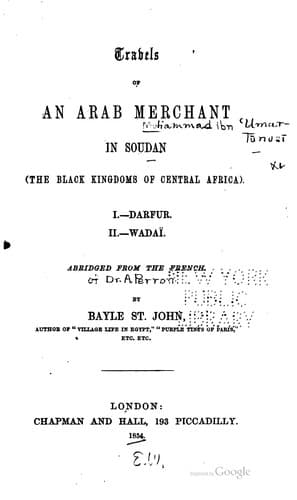
Travels of an Arab merchant in Soudan (the Black Kingdoms of Central Africa)Tūnisī, Muḥammad ibn ʻUmar
History
Travels of an Arab merchant in Soudan (the Black Kingdoms of Central Africa)
Tūnisī, Muḥammad ibn ʻUmar
Darfur (Sudan) -- Description and travel; Wadai (Sultanate) -- Description and travel
My people took me away from the market, beating back the crowd
as we went. It was with some difficulty that we escaped. From
thence we proceeded to a valley, which we found to be shaded by
date-trees and bananas, and some lemon-trees, and plentifully sown
with onions, garlic, red-pepper, cumin, coriander, fenugreek, and
short and long cucumbers. It was autumn, and the dates were just
beginning to blush. They cut for me two clusters of the red fruit,
and two clusters of the yellow, and they gave me a great gourd
full of honey, of which I have never tasted or smelt the equal. We
passed the night pleasantly in that place, and in the morning began
traversing a series of valleys, divided by ranges of hills, each
about a mile in breadth. Everywhere was a luxuriant cultivation,
and the running streams, that glanced over their sandy beds, seemed
like streaks of silver. Each valley is bordered on either hand by
a kind of hedge of trees, which cause it to resemble a winding
avenue. We sat down in a shady place: a fat kid was killed, and
we feasted upon it with delight. We then proceeded to a village at
the foot of the mountain, where we were well received, and rested
till next morning, when we climbed the great range. We were three
hours in reaching the summit. On all sides, upon the slopes, we saw
numerous villages, and an ample population. We were taken to the
Sheikh of the mountain, named Abou-Bekr, whom we found alone. He
was a very old man, covered with wrinkles. When we had saluted him,
he welcomed us, and bade us sit down.
It is remarkable, that the summit of these mountains is only
completely free from clouds for a few days of the year. There
is sufficient rain to allow wheat to come to perfection. Few
harvests can be compared to these, except those of Barbary and
Europe. The rest of Darfur, with the exception of a few cantons,
where well-water is used, does not produce wheat. On a certain day
of the year the Sheikh, or Old Man of the Mountain, of whom we have
spoken, is visited in crowds by the people for consultation. On that
solemn day, set apart for divination, he predicts what is to come
to pass during the year,—drought or rain, war or peace, serenity
or misfortune, disease or health. His prophecies are profoundly
believed; but the Forians differ in opinion about the source and the
cause of the power which he possesses of seeing into the future. Some
pretend that he works by Divine inspiration, and that he who wears
the dignity of Sheikh of the Mountain, is necessarily, and always,
illuminated of God, and a holy personage. This is the explanation
of the learned men of Darfur. Others declare that the genii tell
him what is to come to pass. For my part, I do not know what value
should be assigned to these two opinions; but this I do know, that
many prophecies are attributed to him which have not been fulfilled.
Public-domain text, read in full here on John Shaqi.
Reviews
Reviews
No reviews yet
Be the first to share your thoughts on this work.
Join the Discussion
Join the discussion
Sign in to leave a comment or review.
Sign InorCreate an account