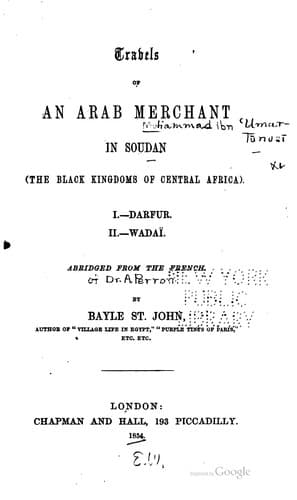
Travels of an Arab merchant in Soudan (the Black Kingdoms of Central Africa) — John Shaqi
Travels of an Arab merchant in Soudan (the Black Kingdoms of Central Africa)Tūnisī, Muḥammad ibn ʻUmar
History
Travels of an Arab merchant in Soudan (the Black Kingdoms of Central Africa)
Tūnisī, Muḥammad ibn ʻUmar
Darfur (Sudan) -- Description and travel; Wadai (Sultanate) -- Description and travel
On hearing the contents of our firman, the Old Man of the Mountain
overwhelmed us with kindness, and ordered a meal to be prepared. Then
he sent out some one to the east of the hill with orders to beat
the great tambourine, called “Tenbel,” and presently from all
sides numerous people came streaming towards us. From the crowd thus
collected he chose a hundred young men, and appointed over them,
as chief, one of his relations, called the Fakih Zaid, celebrated
for his courage. He expressly ordered this troop not to quit me
for a moment, and to be ever on their guard against the rustic
brutality of the mountaineers.
We got on horseback and rode away over the high land towards a
solitary peak which specially bears the name of Marrah, and from
which the whole chain has so been called. There we found a kind of
small oratory, esteemed highly sacred by the people, who venerate it
equally with the mosques. An enormous tree overshadows this oratory,
on which the sun never shines. We entered and sat down awhile. There
are several servants of the place whose duty it is to keep it clean,
and to receive the offerings or ex-votoes of visitors.
Proceeding on our journey, the soldiers of Zaid marching in front,
we soon beheld a multitude of men and women running towards us from
all sides. I was looked upon as an extraordinary being. There was
a perfect scramble to get sight of me. They pushed and shoved one
another, and though the escort closed around they could scarcely
keep off the crowd. These strange people were saying one to the
other, “The Sultan has sent to us a man born before his time,
that we may eat him.” Others exclaimed, “No; this is not a human
being, but an animal under the form of a man, whose flesh is good
to eat.” These mountaineers cannot believe in the existence of
men with white skins and rosy complexions.
These savages know of Arabic only the few words which compose the
confession of faith, and these they pronounce wildly with a broken,
jerking manner. However, the agreeable reflections of the populace
were translated to me, and I became afraid. Zaid also, finding it
impossible to keep off the crowd in any other way, told me to hide
my face in the shawl of my turban, leaving only my eyes visible;
so I veiled myself and stood in the midst of the soldiers. The
negroes, no longer seeing my face, were stupified and said,—
“Where is the red fellow?”
“He has returned to the Sultan,” was the reply, and by degrees
they left us.
We now proceeded to the state-prisons, that is to say, the caverns
where the sons of princes and viziers are incarcerated. The gaolers
at first plumply refused admission, and we almost came to a serious
quarrel, but Zaid read out my firman, and the chief was calmed. He
then said that I might go into the caverns alone, if I pleased, but
that my companions must remain aloof. I refused to take advantage
of this permission, fearing that some evil might befall me, and
expressed my wish to depart.
Public-domain text, read in full here on John Shaqi.
Reviews
Reviews
No reviews yet
Be the first to share your thoughts on this work.
Join the Discussion
Join the discussion
Sign in to leave a comment or review.
Sign InorCreate an account