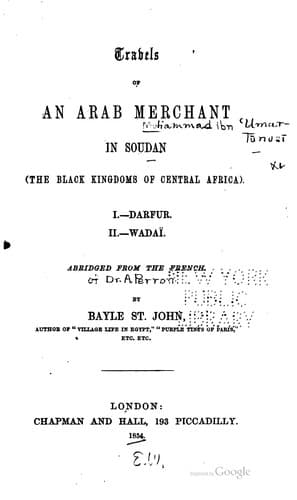
Travels of an Arab merchant in Soudan (the Black Kingdoms of Central Africa)Tūnisī, Muḥammad ibn ʻUmar
History
Travels of an Arab merchant in Soudan (the Black Kingdoms of Central Africa)
Tūnisī, Muḥammad ibn ʻUmar
Darfur (Sudan) -- Description and travel; Wadai (Sultanate) -- Description and travel
It is the custom among the mountaineers of Marrah, that no one
shall marry a woman until he has lived with her, and had by
her one or two children, and thus convinced himself that she is
fruitful. Then the man remains with the woman, and regards her as
his wife. Women do not, as with us, avoid the society of men. If a
husband, on returning home, finds his wife conversing with a man,
he is not angry unless with good cause. Young boys and girls do not
conceal any part of their bodies until the age of puberty. At that
age the boys wear a shirt and the girls a kind of short petticoat;
but from the navel upwards they remain quite naked.
The Forians of Marrah are brutal and passionate, especially in a
state of drunkenness. They are excessively avaricious, and never
receive any guests besides their parents, except for interested
motives. They have no idea of cleanliness, no variety or art in the
preparation of their food; they eat indifferently whatever they see
that seems eatable. Bitter or rotten substances are not cast away,
and they sometimes even prefer this kind of food to others. In every
village the young men have a chief whom they call Wornan, and the
young girls also have a chief called Meirem. On days of rejoicing,
festivals and ceremonies, the Wornan assembles his lads, and all
go and sit down in a large place. Then the Meirem appears with her
damsels, and advances a little a-head of them and sits down. The
chief of the young men comes forward and talks with her, and then she
orders her girls to divide themselves among the youths; so each one
takes away a companion and goes and passes the time where he pleases.
In Darfur the men devote themselves alone to no trade except that
of war, from which alone the women are dispensed. Both sexes follow
their occupations pell-mell, except that the most fatiguing work is
given to the women. Men and women remain always together night and
day; and it is remarkable that, contrary to the opinion of Europe,
the constant society of the female sex does not in any way soften
the manners of the country. The people of Marrah do not consume
the wheat which they harvest, but sell it and buy millet.
Public-domain text, read in full here on John Shaqi.
Reviews
Reviews
No reviews yet
Be the first to share your thoughts on this work.
Join the Discussion
Join the discussion
Sign in to leave a comment or review.
Sign InorCreate an account