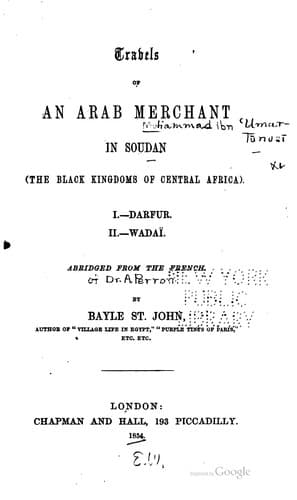
Travels of an Arab merchant in Soudan (the Black Kingdoms of Central Africa) — John Shaqi
Travels of an Arab merchant in Soudan (the Black Kingdoms of Central Africa)Tūnisī, Muḥammad ibn ʻUmar
History
Travels of an Arab merchant in Soudan (the Black Kingdoms of Central Africa)
Tūnisī, Muḥammad ibn ʻUmar
Darfur (Sudan) -- Description and travel; Wadai (Sultanate) -- Description and travel
The most singular thing I heard related whilst I was in these
mountains is this, that the genii act as guardians of the cattle. It
is for this reason that the herds are left to wander where they
will. Many persons assured me seriously that if any one, passing
near a flock and seeing it without a guard, should attempt to
steal a sheep or a cow, and to kill the beast, his hand, still
armed with the knife, would remain fastened to the throat until
the arrival of the owner. I have a hundred times heard instances
of protection afforded by the genii, but was at first inclined
to reject the whole as lies and dreams. But this is what happened
to myself. Being near the Marrah mountains I went to a person of
Numleh, to question him about the genii. On drawing near his hut
I saw nobody, but began to call him by his name. Then a loud and
terrible voice, which made me shiver, shouted “Akibe!” that is
to say, “He is not here.” Nevertheless, I was going to advance
and pursue my inquiries, when an individual, who was passing by me,
took me by the arm and drew me away, saying,—
“Be off! be off! He who speaks to thee is not a human being.”
“And what is he, then?”
“He is the guardian genius of the hut. Nearly every one of us is
thus protected. We call the genii in Forian, Damzog.”
Upon this I feared and withdrew.
On returning from the Marrah to the Fasher, I went to visit the
Shereef Ahmed Bedawee, who had brought me from Cairo to Darfur,
and related to him this adventure and my terror. “The man was
perfectly right,” said Ahmed, who went on to relate to me things
still more wonderful. “At the time when I first began to trade,
my friend, I often heard that damzogs could be bought and sold,
and that to procure one I must apply to the owner of a damzog, and
discuss the price with him. When the bargain is concluded, it is
necessary to give a large gourd of milk to the seller, who takes it
to his house, where are his damzogs. On entering he salutes them,
and goes and hangs up his vase to a hook, saying,—‘One of my
friends—such a one—very rich, is in fear of robbers, and asks
me to supply him with a guardian. Will one of you go and live in his
house? There is plenty of milk there, for it is a house of blessing,
and the proof thereof is, that I bring you this kara of milk.’
The damzogs at first refuse to comply with the invitation. ‘No,
no,’ say they, ‘not one of us will go.’ The master of the
hut conjures them to comply with his desires, saying,—‘Oh! let
the one that is willing descend into the kara.’ He then retires
a little, and presently one of the damzogs is heard to flop into
the milk, upon which he hastens and claps upon the vase a cover
made of date-leaves. Thus stopped up he unhooks the kara, and
hands it over to the buyer, who takes it away and hangs it on the
wall of his hut, and confides it to the care of a slave or of a
wife, who every morning comes and takes it, emptying out the milk,
washing it and re-plenishing it, and hanging it up again.
Public-domain text, read in full here on John Shaqi.
Reviews
Reviews
No reviews yet
Be the first to share your thoughts on this work.
Join the Discussion
Join the discussion
Sign in to leave a comment or review.
Sign InorCreate an account