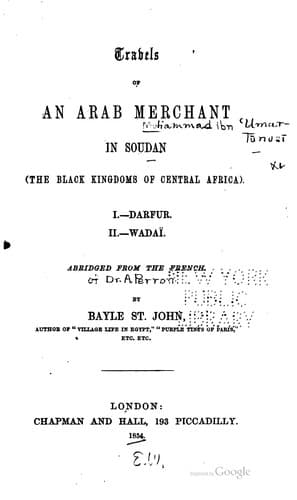
Travels of an Arab merchant in Soudan (the Black Kingdoms of Central Africa)Tūnisī, Muḥammad ibn ʻUmar
History
Travels of an Arab merchant in Soudan (the Black Kingdoms of Central Africa)
Tūnisī, Muḥammad ibn ʻUmar
Darfur (Sudan) -- Description and travel; Wadai (Sultanate) -- Description and travel
The habits and manners of the other tribes of Darfur, such as
the Berti, the Dajo, the Bijo, &c., are pretty nearly the same as
those of the people of Marrah. If some of them differ by being more
hospitable and benevolent, they owe this improvement to association
with Bedawin Arabs, and of the merchants who come to them from Egypt
and other distant countries. Those who received strangers best are
those who speak the Arabic language.
CHAPTER VI.
Philosophy of Geography — Absolute Authority of Princes — Order
of Succession — Old Women Counsellors — Strange Customs —
Public Audiences — Servility — Barbarian Etiquette — Clothing
of the Buaso — Superstitions — Festival of the Sowing — Court
of Tendelty — A Perilous Office — Taxes — King of the Buffoons
— Birds of the South — Music and Songs — Abd-er-Rahman and
the Ulemas — The Yakoury — Queen Mothers.
In examining the different forms of empire, the varieties of tastes
and habits, it is evident that the great Creator—may His Majesty
be glorified!—has multiplied their different aspects in order
to show us the immensity of his power and the profoundness of his
wisdom. Moreover, God has impressed a different character on every
climate. There are cold climates and hot climates, and temperate
climates, according to their distance from the equinoctial line. If
God had wished it, he could have made of all nations a single nation;
but he has assigned to them dissemblances, in order to incite men
to travel, and to learn that of which they are ignorant. Having
stated these truths, let us come to the point.
The Forian princes have customs different from those of other
princes. The sovereign of Darfur exercises boundless despotic
power. He may put to death thousands of individuals, and no one
asks him wherefore. He may degrade whom he pleases, and no one asks
him wherefore. His orders, however adverse they may be, are always
obeyed, and no one resists, even by a word. The only resource is
to cry for mercy; but, if the Sultan chooses to commit an act of
injustice, the hatred it excites remains for ever concealed.
In Darfur the sovereign must be of the blood of the Sultans. No
stranger, not even a descendant of the Prophet, can pretend to the
throne. When a prince is invested with power, he rests for a week
in his dwelling, without issuing orders of any kind. During this
space of time no affair is brought before his tribunal. The Sultan
Abd-er-Rahman was the first who derogated from this custom.
Public-domain text, read in full here on John Shaqi.
Reviews
Reviews
No reviews yet
Be the first to share your thoughts on this work.
Join the Discussion
Join the discussion
Sign in to leave a comment or review.
Sign InorCreate an account