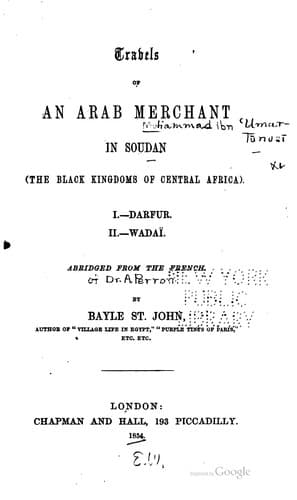
Travels of an Arab merchant in Soudan (the Black Kingdoms of Central Africa)Tūnisī, Muḥammad ibn ʻUmar
History
Travels of an Arab merchant in Soudan (the Black Kingdoms of Central Africa)
Tūnisī, Muḥammad ibn ʻUmar
Darfur (Sudan) -- Description and travel; Wadai (Sultanate) -- Description and travel
The Forian Sultans are surrounded by a kind of Aulic body, composed
of old women, called Habbobah, under the orders of one of their
numbers, called the queen. When the Sultan leaves his privacy of
seven days these old women unite, bearing iron switches, about
two feet long, which they clash one against another, producing a
singular sound. One of them bears a kind of broom of date-branches,
which she dips into a prepared liquid, and therewith, from time to
time, sprinkles the Sultan, uttering certain mysterious words. Then
they conduct the new prince from his private dwelling to the House
of Brass, where the tymbals of the Sultan are kept. Having entered,
they take the Victorious tymbal and place it in the midst. The Sultan
remains alone with the Habbobah, who continue to clash their twigs
of iron, and to repeat their mysterious exclamations. After this
ceremony they lead the prince to the place where is the imperial
throne.
The movement of public affairs now begins, and the sovereign opens
his Divan. He never addresses the ordinary words of salutation
to any one, however great, except through the medium of an
interpreter. Those who obtain audience place themselves on their
knees, and an interpreter repeats their names, adding a form of word
to this effect: “Such a one salutes you humbly.” Having gone
through the whole, he adds, “and their people or their children
are behind them.” Then the negroes, who are standing in the rear
of the prince, begin to cry out “Salutation! salutation!” If the
assembly is great, a large wooden urn, shaped like an inverted cone,
and covered with a skin, called a dingar, is beaten. It gives a great
sound, and is not used on any other occasion. On grand occasions,
there are seven interpreters ready to explain the petitions of
persons who come to ask for justice. The forms of salutation are
very intricate.
The people of Darfur have many singular ways of expressing veneration
for the majesty of the Sultan. Among others, whenever he clears
his throat, his spittle is immediately gathered up from the ground
by his servants with their hands.[14] When he coughs, as if about
to speak, everybody makes the sound of _ts_, _ts_ as nurses do to
amuse their little ones; and, when he sneezes, the whole assembly
imitates the cry of the jeko, which resembles that of a man urging
on his horse to speed. In grand council, the Sultan is fanned with
a large bunch of ostrich-feathers. When he goes out to hunt he is
shaded by a parasol of the same material; and these insignia are
under the special care of a high official. If the Sultan, being
on horseback, happens to fall off, all his followers must fall off
likewise; and should any one omit this formality, however great he
may be, he is laid down and beaten.[15]
Public-domain text, read in full here on John Shaqi.
Reviews
Reviews
No reviews yet
Be the first to share your thoughts on this work.
Join the Discussion
Join the discussion
Sign in to leave a comment or review.
Sign InorCreate an account