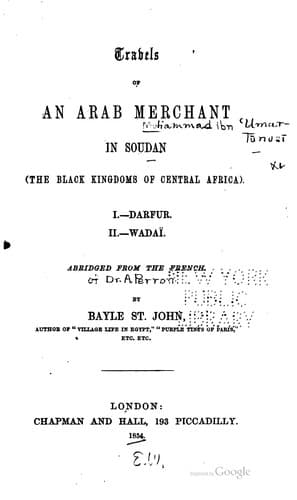
Travels of an Arab merchant in Soudan (the Black Kingdoms of Central Africa)Tūnisī, Muḥammad ibn ʻUmar
History
Travels of an Arab merchant in Soudan (the Black Kingdoms of Central Africa)
Tūnisī, Muḥammad ibn ʻUmar
Darfur (Sudan) -- Description and travel; Wadai (Sultanate) -- Description and travel
There is a remarkable custom, called the Festival of the Sowing,
in Darfur. The Sultan possesses, as his domain, cultivable land,
which is sown every year. After the rains, he goes forth in great
pomp, escorted by more than a hundred young women, chosen amidst
the most beautiful, and adorned with their richest garments and
jewels. These women are the best-beloved of his harem. They wear
upon their heads vases filled with the most delicate viands, and
they walk behind the Sultan’s horse with the young slaves, called
korkoa, armed with lances, and with a troop of flute-players. They
move on with music and singing, and even the young girls join in the
concert. When the prince has reached the open country, he gets out of
the saddle, and taking different kinds of grain whilst a slave turns
up the ground with a hoe, casts them in. This is the first seed that
falls in the country where the Sultan then is. Afterwards the kings,
viziers, the officers of the court, following the example of the
Sultan, also cast in grain, and the whole plain is soon quickened
for the harvest. This done, the dishes are brought by the young
girls, and spread out before the Sultan, who begins to eat with
his courtiers. Then the whole party get into the saddle again,
and return in a grand cavalcade to the Fasher. This Festival of
the Sowing is one of the most solemn in Darfur.[16]
The court of Tendelty is organised in a very complete and singular
manner. The different dignitaries are named after different parts
of the Sultan’s body. The Orondolon, for example, means the head
of the Sultan, and his duty is to march in the van of the troops;
the Kamneh, or neck of the Sultan, is still higher in rank, but
his privileges are counterbalanced by one extraordinary duty,
viz. that of allowing himself to be strangled if the king happens
to be killed in battle. After these functionaries come the backbone,
and the right arm, and the left arm, each with different duties. The
Ab-Sheikh, or Father-Sheikh, is above all the before-mentioned
dignitaries in rank. He is almost the equal of the Sultan, and
possesses the right of life and death without control. There are
numerous other officials, each with distinct duties. One of the
principal is the King of the Door of the Women, or Chief of the
Eunuchs. There is also the King of the Slaves, of the Custom-House,
and of the Tax-gatherers. None of these officers receive any direct
payment, but all have extensive districts assigned to them, from
the revenues of which they are expected to supply arms, clothing,
and horses for themselves and their soldiers.
Public-domain text, read in full here on John Shaqi.
Reviews
Reviews
No reviews yet
Be the first to share your thoughts on this work.
Join the Discussion
Join the discussion
Sign in to leave a comment or review.
Sign InorCreate an account