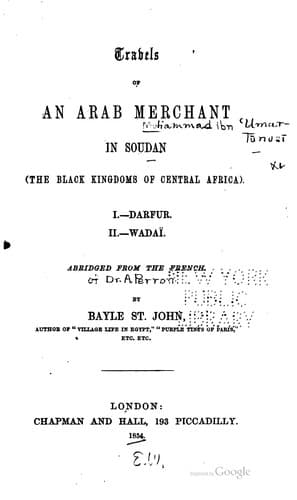
Travels of an Arab merchant in Soudan (the Black Kingdoms of Central Africa)Tūnisī, Muḥammad ibn ʻUmar
History
Travels of an Arab merchant in Soudan (the Black Kingdoms of Central Africa)
Tūnisī, Muḥammad ibn ʻUmar
Darfur (Sudan) -- Description and travel; Wadai (Sultanate) -- Description and travel
The tithe of grain and of cattle belongs exclusively to the Sultan;
but each of the governors has private property, which is cultivated
by forced labour. They have also the right to impound and appropriate
all wandering property, as slaves, oxen, sheep, and asses. All fines
also go to them. For example, if one man wounds another, he pays
so much for the blood spilt, all of which goes to the governor,
whilst, if death ensues, only one-half does, the remainder going
to the parents of the deceased. If a man intrigues with a married
woman, both the guilty parties are compelled to pay a fine. It must
also be remembered that all kinds of labour are taken by force,
and used gratuitously.
I must not forget to speak of the Kingship of the Maugueh, or
Buffoon of the Sultan. This is the least respectable office in
the court, but it is sufficiently interesting to describe. The
Forians have a natural tendency to pleasure, to gaiety, to games,
and festivals. They pass no day without some entertainment; kings and
people share the same passion; and they have invented every possible
means of enjoyment, and all kinds of instruments. Every king has
a train of young boys, chosen for the beauty of their voice, and
called Korkoa. They are supplied with pipes made of reeds, through
which they not only blow, but sing, mixing up the notes and the
words in a singular manner. They are accompanied by a remarkable
instrument, consisting of a dried gourd, in which some pebbles have
been introduced, and which are shaken in time to the notes and
pauses of the flutes. Often the Sultan, on ceremonial occasions,
causes this band to be followed by his harem, bearing dishes;
and on these occasions, a drum resembling the araboukka of Egypt,
is added to the concert. There are masters in Darfur who teach
both music and singing. The singers precede the Sultan in groups,
one individual of which begins a stanza, while the others sing
the chorus. On these occasions, when the whole crowd of horse and
footmen are beating tambourines, or playing on flutes or pipes,
or singing, the noise created is perfectly stunning. The flutes
are called the Birds of the South, because in Southern Darfur are
found many birds with agreeable notes, from which it is said the
Forians have learned their style of playing.
Public-domain text, read in full here on John Shaqi.
Reviews
Reviews
No reviews yet
Be the first to share your thoughts on this work.
Join the Discussion
Join the discussion
Sign in to leave a comment or review.
Sign InorCreate an account