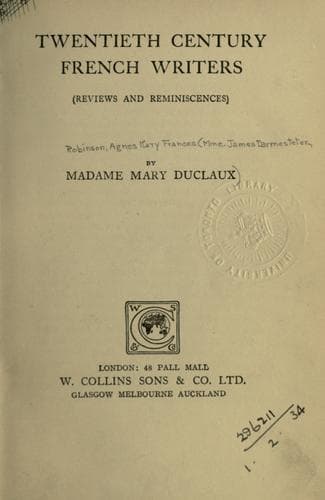
Twentieth Century French Writers: Reviews and ReminiscencesRobinson, A. Mary F. (Agnes Mary Frances)
History
Twentieth Century French Writers: Reviews and Reminiscences
Robinson, A. Mary F. (Agnes Mary Frances)
French literature -- 20th century -- History and criticism
A great gulf divides, as we shall see, the Barrès of the Nineteenth
Century from the Barrès of the Twentieth. We will not consider in
this place that earlier author, the gifted egoist of _Bérénice_, the
anarchist of _L’Ennemi des Lois_, the lonely mystic of _L’Homme libre_,
the dilettante, the self-worshipper. Let us merely say (in order to
explain him) that our author was born in 1862 at Charmes in Lorraine,
a man of a mingled race, with a strain of Teuton in him warring with
the Celt, and a Rhenish sensibility hampered by a Latin love of rule
and law. On his father’s side, he traces his descent to Auvergne, and
his relations still live in the little town of Mur-en-Barrez; but his
mother’s people all come from the neighbourhood of Nancy in Lorraine.
If we gave a free rein to our imagination, and let ourselves argue
from type and talent to a strain of race, we might suppose that, like
Montaigne, Barrès had in his stock some Jewish or Marrana grandmother,
who gave him his taste for speculation, with something curious, double,
and ironical in his outlook; but here, I believe, the genealogists
protest.
His first impressions of conscious and public life were of a kind fit
to aggravate the inherent melancholy of a sensitive and impassioned
nature. He remembers a crowd, all surging towards one point under a
hot summer sun, and that point the station; trains passing endlessly,
filled with soldiers, thousands of soldiers, drunk, some with wine,
some with sheer excitement, and all singing at the top of their voices.
And the inhabitants of the little town of Charmes, men, women, and
especially the little boys like himself, are striving towards, pressing
against, hanging over the barriers and railings of the station, handing
across bottles of wine, brandy, coffee, and crying: ‘_À Berlin!_’ as
loudly as the soldiers. And then a few weeks later, the retreat: that
day of stupefied astonishment in the soaking rain, while horsemen
and infantry in wild confusion troop by in a very rage of shamed
withdrawal; the soldiers insulting their officers, a General in tears,
the linen-clad Turcos shivering in the dreary damp. And then five
Uhlans, their pistols in their hands, who ride across the bridge and
take possession.
The men of the Barrès family, notable citizens of Charmes, were
taken in hostage by the Prussians. The trains that ran the Prussian
troops towards the front had a Barrès or so, as hostages, beside the
engine-driver. Their lives hung by a thread. And so a proud, timid,
melancholy little boy learned early in life what it is to expect the
worst, to go in fear, and, out of pride, to dissimulate that fear. The
Nationalism of Barrès may be traced to these first impressions. It
is as invaders that he hates the Germans: intellectually, he has no
quarrel with them.
Public-domain text, read in full here on John Shaqi.
Reviews
Reviews
No reviews yet
Be the first to share your thoughts on this work.
Join the Discussion
Join the discussion
Sign in to leave a comment or review.
Sign InorCreate an account