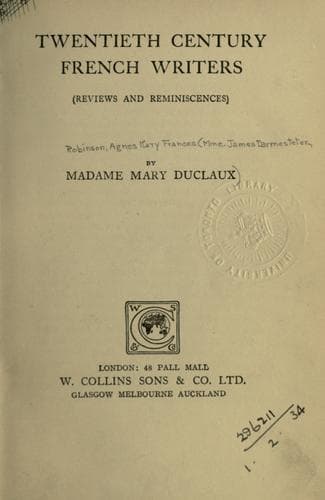
Twentieth Century French Writers: Reviews and Reminiscences — John Shaqi
Twentieth Century French Writers: Reviews and ReminiscencesRobinson, A. Mary F. (Agnes Mary Frances)
History
Twentieth Century French Writers: Reviews and Reminiscences
Robinson, A. Mary F. (Agnes Mary Frances)
French literature -- 20th century -- History and criticism
In a discourse pronounced on the frontier during the war-threatened
summer of 1911, he asserted anew all that he owes to the romantic fancy
of the Rhine, his real and fervent admiration for the noble genius
of Gœthe, his tenderness for the sentimental Schiller, his sense of
a deep interior affinity between his own mind and that of Nietzsche.
But those terrible memories of childhood have graven in his spirit a
certainty of the preciousness (but also of the precariousness, the
fragility) of civilisation; a hate and a contempt for the ‘Barbarians’
whose hordes are a perpetual menace; and a feeling that, though every
nation has plenty of Barbarians at home, the worst of all Barbarians
are the Prussian Uhlans and the Bavarian troopers of a German invasion.
Barrès was the most precocious, I think, of a generation that began
to pierce the soil (so to speak) between 1886 and 1890, a generation
idealist and sceptical at once, which counts among its glories Bergson,
Maurras, Mæterlinck, and (their Benjamin) René Boylesve. At nineteen
years of age, Barrès left Nancy and came up to Paris in order to study
law: his deluded family hoped to make a magistrate of the ‘Ennemi des
Lois.’
But the dreamy youth, silent, timid, yet brilliant, had other aims
in view. He had a volume of Schopenhauer in his pocket and a certain
number of ideas in his head. He began to write in the young reviews and
to show these first essays to his pastors and masters, the two rival
librarians of the Senate, Leconte de Lisle and Anatole France. They
were extraordinary essays which reflected in nothing the physiological
naturalism of the hour--the hour of Zola! They were entirely,
exaggeratedly spiritual and interior, and yet full of the dreariest
nihilism. They were the essays of a man with a soul, who says in his
heart: ‘There is no God.’
Those early essays, those first novels, have nothing to do with the
Barrès of the Twentieth Century, save inasmuch as the child is the
father of the man. I have dealt with them elsewhere (in the _Quarterly
Review_), but some day it will be interesting to take them up again and
examine their development parallel to the philosophy of Bergson. It is
often surprising, and makes one wonder if the two writers have not, in
their philosophy, some common ancestor. But who was he? Was he Burdeau?
Was he Ravaisson? Was he Lachélier? Was he Renouvier?
Public-domain text, read in full here on John Shaqi.
Reviews
Reviews
No reviews yet
Be the first to share your thoughts on this work.
Join the Discussion
Join the discussion
Sign in to leave a comment or review.
Sign InorCreate an account