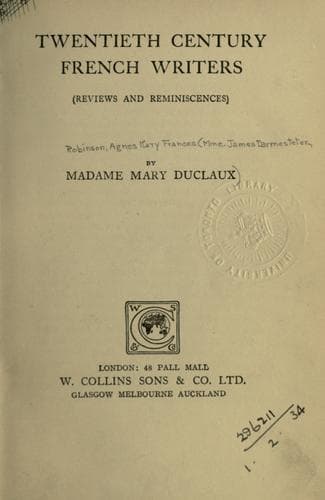
Twentieth Century French Writers: Reviews and ReminiscencesRobinson, A. Mary F. (Agnes Mary Frances)
History
Twentieth Century French Writers: Reviews and Reminiscences
Robinson, A. Mary F. (Agnes Mary Frances)
French literature -- 20th century -- History and criticism
For my present purpose--which is to examine the progress of Barrès,
and especially his influence on recent literature, it is enough to say
that these first volumes were the work of a man for whom the inner
world alone exists. He, who was to become the voice of his province
and his race, makes his first appearance as a being released from all
ties and all traditions. The hero of _Sous l’œil des Barbares_ has no
country, no profession, no family, no local habitation, and no name.
The one existence and the one reality are, in his eyes, the Ego,--in
other words, his own mind. His sole adventure is the lonely courage of
a descent into that Inner Abyss. He might have exclaimed with Leopardi:
‘E dolce, il naufragar in questo mare!’
In the depth of this depth is something deeper still, continuous
beneath the difference of individuals, as the mass of the sea is
one below the variety of the waves. ‘Penser solitairement, c’est
s’acheminer à penser solidairement,’ Barrès exclaimed, half ironically,
in _Les Déracinés_. If we sink deep enough into our own souls, we fall
into the general soul of all: we find the deep subterranean flood that
fills all the fountains of the city!
And so the Egoist discovers that he is not alone, that he is a
living cell in a living organism. It is this sense of Life and
solidarity which distinguishes Barrès, the man of action, Barrès, the
political leader, Barrès, the inventor of Nationalism, the apostle
of decentralisation, from the delightful nihilist, the exquisite
anarchist, that he was at twenty--and even at thirty years of age.
He has gone far since then! Sure, now, of the existence of his race;
accompanied in all his thoughts by those mysterious cohorts of the
dead and the unborn which prolong the importance of the humblest life;
our philosopher bids us lay no stress upon our own experience, and
sacrifice, if needs be, the details of our happiness to the welfare of
the whole.
Slowly this second manner has developed since the closing years of
the last century: between _L’Ennemi des Lois_ (published in 1895) and
_Les Déracinés_ (1897) there is a chasm, an apparent disconnection.
Something mysterious divides them--something akin to a religious
conversion. What is the secret substratum which unites two phases
evidently alike sincere? What makes their diversity none the less
organic? It is, I think, _the sense of continuity_, the desire to
persist and to preserve. The Barrès of _Les Déracinés_ has reached the
further edge of youth: he is five-and-thirty years of age.
Public-domain text, read in full here on John Shaqi.
Reviews
Reviews
No reviews yet
Be the first to share your thoughts on this work.
Join the Discussion
Join the discussion
Sign in to leave a comment or review.
Sign InorCreate an account