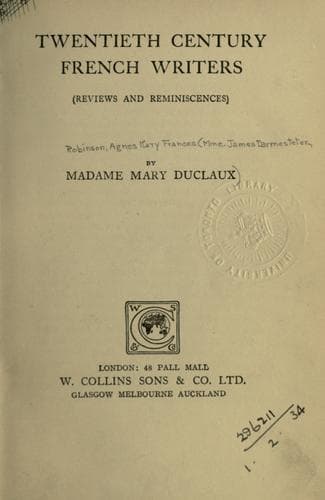
Twentieth Century French Writers: Reviews and ReminiscencesRobinson, A. Mary F. (Agnes Mary Frances)
History
Twentieth Century French Writers: Reviews and Reminiscences
Robinson, A. Mary F. (Agnes Mary Frances)
French literature -- 20th century -- History and criticism
Many men, on the threshold of forty, find themselves suddenly and
terribly alone, in an hour of solemn solstice. So far, they have
struggled up the hill gaily, with companions, and always have seen
their goal ahead, like a cliff that shines in the sun and masks the
horizon. Now on that topmost rock they stand, and now the road slopes
downward--the road leading nowhere--which they must follow with
diminished strength, in dwindling numbers, to find a tomb somewhere at
the foot of the hill. Such an hour, such an experience marks for ever a
sensitive nature. Some, then, like Tolstoi, have suddenly renewed the
faith of their childhood and reconciled themselves with Christianity
for the sake of a promised resurrection. Others build above the abyss a
narrow bridge with the hope of the continuance of their race and their
ideal. So Barrès will one day write:--
‘J’ai confiance, pour atténuer certaines peines morales, dans un
esprit fait de soumission à la terre natale, de fidélité aux morts,
et de connaissance que tous nos actes entreront dans l’héritage
social.’ (_Amitiés Françaises_, p. 41.)
There is at Bar-le-Duc, in the church of Saint-Pierre, a mortuary
statue of the Prince of Orange, by Ligier Richier, that tragic sculptor
who left Lorraine to learn of Michael Angelo. The prince lies in
the tomb, dead, in all the horror of corruption, his flesh dropping
from his bones. But out of that appalling decomposition he lifts his
heart intact--his living, his immortal heart--and he is reconciled
to perish if that alone survive. So all of us, from the De Profundis
of our accepted mortality, raise something we would fain bequeath
as an heirloom to the future. Religion is based on such a sense of
the persistence and the perpetuity of an ideal. Something, at least,
survives; something is incorruptible; Sursum corda! and because of
that persuasion of a continuity assured, the sadness of our own sure
destruction is tempered with serenity and hope.
II
There exist two great families of literary works. One kind is complex,
often diffuse, romantic, representing characters and sentiments too
singular to be recognised save by the chosen few; of such are the
works of Stendhal, and down to the close of the Nineteenth Century the
novels of Barrès belong to this category. But in 1900, with _L’Appel
au Soldat_, he will effect his transition to that other group, which
instinctively we call classic, dealing with the simple sentiments of
general humanity, seen from a great height, plumbed to a great depth.
With _L’Appel au Soldat_, Barrès enters the sphere of Gœthe.
Public-domain text, read in full here on John Shaqi.
Reviews
Reviews
No reviews yet
Be the first to share your thoughts on this work.
Join the Discussion
Join the discussion
Sign in to leave a comment or review.
Sign InorCreate an account