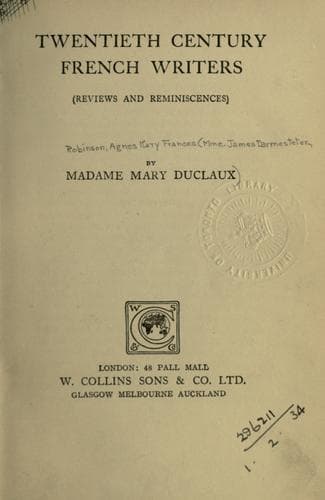
Twentieth Century French Writers: Reviews and ReminiscencesRobinson, A. Mary F. (Agnes Mary Frances)
History
Twentieth Century French Writers: Reviews and Reminiscences
Robinson, A. Mary F. (Agnes Mary Frances)
French literature -- 20th century -- History and criticism
If the book please me greatly, it is less for its animated picture
of the Boulangist fever, for its portrait of the General (so deeply
pathetic in its human weakness), less even for the death of Mme de
Bonnemains (though few things are more heartrending) than for an
interlude of some seven score pages, _La Vallée de la Moselle_, the
simple account of a bicycle tour taken by two young men, natives of
Lorraine, from Bar-le-Duc in France to Coblenz, which once was France.
But these chapters are written with a freshness and a feeling, a
flexibility, an evident sincerity which make them infinitely touching.
That Spanish crudity, bizarre, elliptic, which Barrès used to affect,
has vanished here. A romantic sentiment is expressed with the ripe
calm and in the pure language of a classic. Our Barrès sails his black
Venetian gondola along the most harmonious, amplest stream. He has
forgotten his impertinence and his perversity, but he has lost nothing
of his grace.
Marriage and the birth of a son had, no doubt, much to do with this
happy evolution. To a man haunted by the dread of annihilation, a child
is an assurance against complete extinction. He is (as the Parsees
say in their touching phrase) ‘a bridge’: a bridge across the abyss.
A child prolongs our Ego and assures the continuity of all that we
inherit from our ancestors. A child, we may say, is the printed proof
of our manuscript, safe henceforth, and no longer so unique or so
important!
The volume which Barrès wrote for his little son of six years old is a
sunlit exception in his writings, as a rule so profoundly melancholy.
_Les Amitiés Françaises_ is a First Reader in patriotism, an alphabet
of honour. It is an exquisite book and might take for an epigraph the
motto of the town of Toul: _Pia, pura, fidelis_. It is the notebook
of an observer who is a poet, of a poet who is a philosopher, of a
philosopher who is a father; yet even here I distinguish that subtle,
poignant note of suffering egotism, as inseparable from Barrès’ work
as from that of Chateaubriand. There are moments (as in the anecdote
called _Le Trou_) when this mournful undertone rises almost to the
pitch of rancour--a rancour almost immediately caught up, it is true,
in a passion of tenderness and gratitude. The child, Philippe, shall
see the light of the sun so many years after the abyss shall have
swallowed up the father!
‘Non, Philippe, tu ne glisseras dans le trou que trente années
après que j’y serai--vingt années après que ta petite maman y sera.
Tant je que demeurerai, jamais Philippe n’ira dans le trou!’
Public-domain text, read in full here on John Shaqi.
Reviews
Reviews
No reviews yet
Be the first to share your thoughts on this work.
Join the Discussion
Join the discussion
Sign in to leave a comment or review.
Sign InorCreate an account