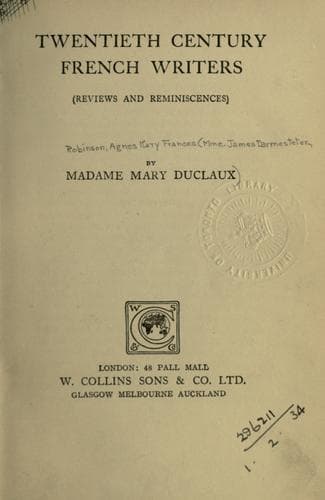
Twentieth Century French Writers: Reviews and ReminiscencesRobinson, A. Mary F. (Agnes Mary Frances)
History
Twentieth Century French Writers: Reviews and Reminiscences
Robinson, A. Mary F. (Agnes Mary Frances)
French literature -- 20th century -- History and criticism
And the same passionate prolongation shows itself at another moment
in a tender encroachment, a yearning monopoly, as though the father
would engross and captivate the child and make him his, nay, make him
_he_!--pour into this new vial the old wine of his own heart, fill the
transparent and unsullied vase with the precious vintage which it shall
carry safely for one more season, decanted, as it were, from one vessel
into another. The child is a new lease of life; the child is a bath of
renewal; new eyes wherewith to see things in the old forgotten glamour;
new ears with which to hear delicate sounds that this long while have
escaped the father’s thickening tissues; above all the child is an
innocence, a freshness unspeakable:--
‘Tu vis chacune de mes heures. Avec toi je repasserai par mon
humble sentier. Ô ma jeunesse, ma plus bête et jeune jeunesse, qui
refleurit! Quand j’étais rassasié, voilà que, par cet enfant, je me
retrouve à jeune devant le vaste univers.’
This pater-familias had been the most passionate of pilgrims.
Under the correctness and irony of his style there had trembled an
exasperated sensibility. Impassioned and methodical, enthusiastic
and circumspect, chimerical and positive, two natures had warred in
Barrès; their conflict had been at once his torment and his delight;
and the most romantic of European landscapes had long been the
battlefield of their interior quarrel. On the red and sunburned hills
of Toledo, Barrès had mused on the cruelty of sensual passion and on
the imminence of death; he had meditated in the cathedral and had read
the inscription on a pavement at his feet: ‘Hic jacet pulvis, cinis, et
nihil.’ And Venice had dissolved in his veins her enervating beauty.
But now it was towards Sparta that he took the road. The very title is
a programme--_Le Voyage de Sparte_! (1906).
Of all the glorious memories of Greece there is nothing that
so much attracts our traveller as the memory of two foreign
visitors--Chateaubriand and Lord Byron; the pathetic rather than the
heroic remains his ideal still. Yet little by little Athena draws his
soul towards her; first by Antigone, a figure at once pathetic and
heroic, faithful to her dead, a holocaust to her race; and next by
the tombs of Greece, sepulchres carved over with images of beauty and
regret, yet without despair or anguish. They teach that calm acceptance
of the inevitable which is more than resignation, which is serenity.
Public-domain text, read in full here on John Shaqi.
Reviews
Reviews
No reviews yet
Be the first to share your thoughts on this work.
Join the Discussion
Join the discussion
Sign in to leave a comment or review.
Sign InorCreate an account