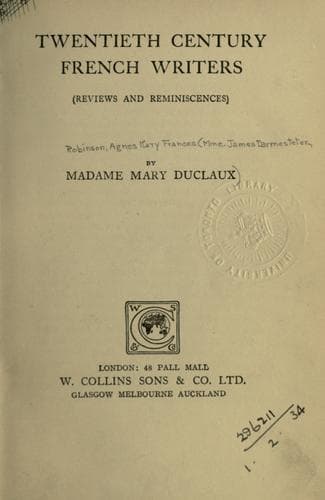
Twentieth Century French Writers: Reviews and ReminiscencesRobinson, A. Mary F. (Agnes Mary Frances)
History
Twentieth Century French Writers: Reviews and Reminiscences
Robinson, A. Mary F. (Agnes Mary Frances)
French literature -- 20th century -- History and criticism
And one day, on the banks of the Eurotas, Barrès discovers a form of
beauty novel to his soul, made of measure and ease and grace, without
excess or rapture. ‘On y trouve des beautés que l’on peut aimer sans
souffrir!’ The sense of the whole, the acceptance of the inevitable,
the tranquilness of Art, ‘épuré de tous éléments de désespoir,’ these
are conceptions which, if properly assimilated, are a liberal education
for a Romantic. Barrès could not say, like Gautier, ‘La vue du
Parthénon m’a guéri de la maladie gothique;’ the process was slow and
painful, and the inoculation of the antique was followed by a violent
and feverish reaction. Between him and that unequalled past there is a
solution of continuity; it is a perfection into which he cannot enter,
for lack of a few drops of Greek blood in his veins; yet he has had his
lesson, which he will not forget, and bears away with him a counsel to
ponder in his heart.
‘La déesse m’a donné, comme à tous ses pèlerins, le dégoût de
l’enflure dans l’art. Il y avait une erreur dans ma manière
d’interpréter ce que j’admirais; je cherchais un effet, je tournais
autour des choses jusqu’à ce qu’elles parussent le fournir.
Aujourd’hui j’aborde la vie avec plus de familiarité, et je désire
la voir avec des yeux aussi peu faiseurs de complexités théâtrales
que l’étaient des yeux grecs.’
In this new mood of simplicity and responsibility, Barrès conceived
two short novels, companion pictures, lessons in civic virtue; one
for a man, the other for a girl: _Au Service de L’Allemagne_ (1905),
and _Colette Baudoche_ (1909). The theme of the first occurs already
in _L’Appel au Soldat_, where the two heroes examine the situation
of a young French Lorrainer under a German government. When the hour
comes for his military service, shall the young man desert across the
frontier to a land where he is scarce accounted French, or drafted off
into the Légion Étrangère? Or shall he bow the neck to the usurper? And
to whom shall he owe allegiance in case of war: France or Germany?
The hero of _Au Service de L’Allemagne_ is a young Alsatian, whose
very name is a symbol: Ehrmann, the man of honour. He is the son of
one of those old autochthonous families who, under German rule, remain
at heart profoundly French; whose ancestors have fought the battles of
Louis Quatorze and Napoleon; who continue to talk French by their own
fireside. In Alsace-Lorraine they are at home; in France, almost as
much as in Germany, they are across the border. The French novelist has
hitherto taken for granted that his hero should _opter pour la France_;
yet in this fashion, without great profit to the mother country,
Alsace-Lorraine is being emptied of her French blood.
Public-domain text, read in full here on John Shaqi.
Reviews
Reviews
No reviews yet
Be the first to share your thoughts on this work.
Join the Discussion
Join the discussion
Sign in to leave a comment or review.
Sign InorCreate an account