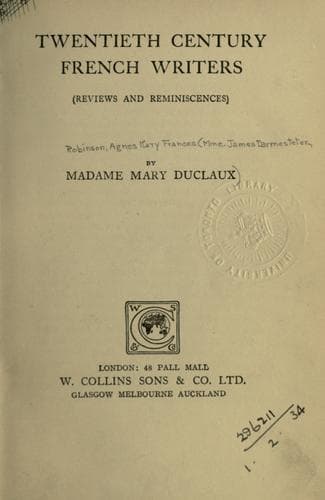
Twentieth Century French Writers: Reviews and Reminiscences — John Shaqi
Twentieth Century French Writers: Reviews and ReminiscencesRobinson, A. Mary F. (Agnes Mary Frances)
History
Twentieth Century French Writers: Reviews and Reminiscences
Robinson, A. Mary F. (Agnes Mary Frances)
French literature -- 20th century -- History and criticism
Let the Alsatian serve his time in a German regiment, says Maurice
Barrès; and, afterwards, let him live his life as an Alsatian doctor
among Alsatian patients; as an Alsatian manufacturer among Alsatian
workmen; let him remain true to ‘La Terre et les Morts!’ Let him march
in the ranks with comrades who may be the foes of to-morrow, for his
first duty is neither to Germany, which has annexed him against his
will, nor to France, which stirs not a finger to let him out of prison,
but to Alsace-Lorraine, the home of his race. So Ehrmann invents a new
casuistry which, in an impossible situation, satisfies his conscience:
he will serve his time in a German corps, reserving the right to desert
in case of a war with France. But, even in that extremity, he will be
no spy; he will reveal no secret learned during the time of compulsory
service; he will observe towards his old colours a loyalty absolute
while it lasts, which shall be succeeded by a faithful silence.
The sacrifice of Colette Baudoche, if not more difficult or more
meritorious, is simpler and easier to admire. There lives in an old
house at Metz an old _bourgeoise_, Madame Baudoche, the widow of a
land agent, and her young orphaned granddaughter, Colette. To eke out
their narrow means, the two women do a little dressmaking among the
neighbours who have known them in happier days, and let their two front
rooms. Enters to them a young Prussian schoolmaster at the Lycée (the
‘gymnasium’), and he becomes their lodger. Asmus is a good young bear,
a friendly and cordial young bore. It is his first contact with the
Spirit of France--with ease, measure, liberty, and grace--qualities
which the young German begins by admiring as French, but soon ends by
loving as peculiar to Colette Baudoche.
Asmus is the most generous of conquerors, for his heart is filled by a
tender admiration for the vanquished. He listens to, looks at, admires
all that springs from the trampled soil. His love of Nature--which at
first is vague and pantheistic--takes on the tone of France and becomes
human, historical, and scientific. His rich but rough nature acquires
finer shades and subtler blendings; in fact, little by little, Lorraine
recreates the German tyrant in her own image:--
‘Il y a des petits villages, isolés au milieu des espaces ruraux,
qui, le soir, à l’heure où l’on voit rentrer les bêtes et les gens,
m’apparaissent comme des gaufriers; et je crois que tout être, fut
il barbare prussien, soumis à leur action patiente et persistante,
y deviendrait lentement Lorrain. Bien des générations reposent
là, au cimetière, mais leur activité persiste; elle est devenue
ce groupe de maisons, ce clocher, cet abreuvoir, cette école
qu’entourent les champs bigarrés de couleurs et de formes; et si
l’on entre dans cette communauté, on y vient nécessairement à se
conduire et penser comme ont fait les prédécesseurs.’
Public-domain text, read in full here on John Shaqi.
Reviews
Reviews
No reviews yet
Be the first to share your thoughts on this work.
Join the Discussion
Join the discussion
Sign in to leave a comment or review.
Sign InorCreate an account