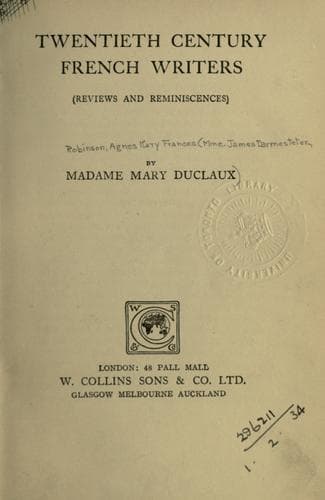
Twentieth Century French Writers: Reviews and ReminiscencesRobinson, A. Mary F. (Agnes Mary Frances)
History
Twentieth Century French Writers: Reviews and Reminiscences
Robinson, A. Mary F. (Agnes Mary Frances)
French literature -- 20th century -- History and criticism
The final volume takes us back to Paris, and thence to Rome. Christophe
is now the genius of his age, but his personal life is still meagre
and sad; no wife, no child, no friend, no love, concentrates its
elixir in one golden drop. And one day in the Alps he meets--as a
middle-aged woman, a widow still charming in her tired grace and
kind serenity,--that Countess Berény whom he had known as a girl in
Paris, long ago. And Grazia Berény incarnates indulgent lazy Italy;
as Anna Braun, Switzerland; as Henriette Jeannin, France; as the
dear, feckless, gentle Sabina, South Germany; in the long gallery of
Christophe’s lady-loves.
Of them all, it is Grazia that he desires to marry. But Grazia,
indifferent and gentle, loves Christophe less than her quiet days, her
children’s interests, her pleasant, nonchalant, and sociable life of a
handsome widow ‘well left,’ who cares above all things for her _quieto
vivere_. She is not very interesting, this Grazia, so much in love with
peace and measure; she and Christophe would have been as well mated as
a sleek and sober Angora with a mastiff ever on the growl (though his
bark is worse than his bite), and we are not very sorry when she dies.
We have wept so many tears for poor old Louisa (Christophe’s mother),
for Sabine, for Antoinette, for Olivier, that we have none to spare for
the passive and elegant great lady. Neither in the painting of Grazia
nor in his image of Rome is our author to be seen at his best. And yet
what citizen of Cosmopolis knows Rome as well as Romain Rolland?
By the end of this tenth volume, Jean-Christophe is no longer young,
and all has happened to him that reasonably could be expected to
happen. He has mixed in the politics of several nations, he has known
fight and flight and exile; he has been poor, he has been famous; he
is now the greatest musician of his times. The most exacting reader
could not wish to stretch him out much longer on the rack of this tough
world. There are ten sizable volumes of him at Mr Ollendorff’s--or,
if you prefer, seventeen of those wonderful little ‘Cahiers de la
Quinzaine’ (beloved of garrulous and expansive genius) in which M.
Charles Péguy has produced not only M. Romain Rolland, but himself.
Now we know all there is to know, and find that (as in real life) the
climax is middling compared to the hopes of youth.
Jean-Christophe dies a genius; but we, after all, have never heard his
operas. He dies, like any other mortal whom a living faith sustains
in the last hour of all. The death of Jean-Christophe has probably
preoccupied more readers than the end of any other hero in fiction
since the great days of Dickens and Thackeray. We ourselves know one
eminent hand in letters who wrote to the author suggesting that his
hero should disappear in the wreck of the _Titanic_, conducting the
band, in place of the unforgettable bandmaster. Another wished him to
wander away alone and die in the desert, after the fashion of Tolstoi.
Public-domain text, read in full here on John Shaqi.
Reviews
Reviews
No reviews yet
Be the first to share your thoughts on this work.
Join the Discussion
Join the discussion
Sign in to leave a comment or review.
Sign InorCreate an account