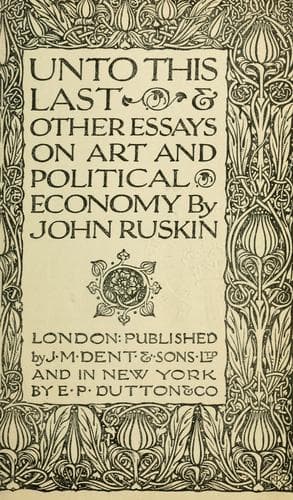
Unto This Last, and Other Essays on Political EconomyRuskin, John
General
Unto This Last, and Other Essays on Political Economy
Ruskin, John
Art; Economics
Quitting, however, at last these general and serious laws of
government--or rather bringing them down to our own business in
hand--we have to consider three points of discipline in that
particular branch of human labour which is concerned, not with
procuring of food, but the expression of emotion; we have to consider
respecting art: first, how to apply our labour to it; then, how to
accumulate or preserve the results of labour; and then, how to
distribute them. But since in art the labour which we have to employ
is the labour of a particular class of men--men who have special
genius for the business, we have not only to consider how to apply the
labour, but first of all, how to produce the labourer; and thus the
question in this particular case becomes fourfold: first, how to get
your man of genius; then, how to employ your man of genius; then, how
to accumulate and preserve his work in the greatest quantity; and
lastly, how to distribute his work to the best national advantage. Let
us take up these questions in succession.
I. DISCOVERY.--How are we to get our men of genius: that is to say, by
what means may we produce among us, at any given time, the greatest
quantity of effective art-intellect? A wide question, you say,
involving an account of all the best means of art education. Yes, but
I do not mean to go into the consideration of those; I want only to
state the few principles which lie at the foundation of the matter. Of
these, the first is that you have always to find your artist, not to
make him; you can't manufacture him, any more than you can manufacture
gold. You can find him, and refine him: you dig him out as he lies
nugget-fashion in the mountain-stream; you bring him home; and you
make him into current coin, or household plate, but not one grain of
him can you originally produce. A certain quantity of art-intellect is
born annually in every nation, greater or less according to the nature
and cultivation of the nation or race of men; but a perfectly fixed
quantity annually, not increaseable by one grain. You may lose it, or
you may gather it; you may let it lie loose in the ravine, and buried
in the sands, or you may make kings' thrones of it, and overlay temple
gates with it, as you choose: but the best you can do with it is
always merely sifting, melting, hammering, purifying--never creating.
And there is another thing notable about this artistical gold; not
only is it limited in quantity, but in use. You need not make thrones
or golden gates with it unless you like, but assuredly you can't do
anything else with it. You can't make knives of it, nor armour, nor
railroads. The gold won't cut you, and it won't carry you; put it to a
mechanical use, and you destroy it at once. It is quite true that in
the greatest artists, their proper artistical faculty is united with
every other; and you may make use of the other faculties, and let the
artistical one lie dormant. For aught I know, there may be two or
Public-domain text, read in full here on John Shaqi.
Reviews
Reviews
No reviews yet
Be the first to share your thoughts on this work.
Join the Discussion
Join the discussion
Sign in to leave a comment or review.
Sign InorCreate an account