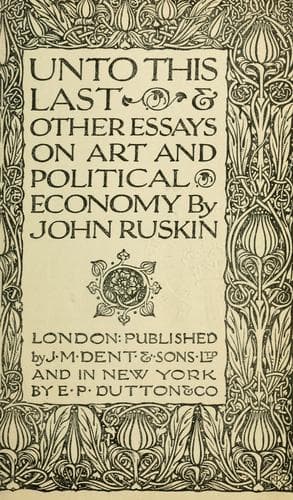
Unto This Last, and Other Essays on Political Economy — John Shaqi
Unto This Last, and Other Essays on Political EconomyRuskin, John
General
Unto This Last, and Other Essays on Political Economy
Ruskin, John
Art; Economics
three Leonardo da Vincis employed at this moment in your harbours and
railroads: but you are not employing their Leonardesque or golden
faculty there, you are only oppressing and destroying it. And the
artistical gift in average men is not joined with others; your born
painter, if you don't make a painter of him, won't be a first-rate
merchant, or lawyer; at all events, whatever he turns out, his own
special gift is unemployed by you; and in no wise helps him in that
other business. So here you have a certain quantity of a particular
sort of intelligence, produced for you annually by providential laws,
which you can only make use of by setting it to its own proper work,
and which any attempt to use otherwise involves the dead loss of so
much human energy. Well, then, supposing we wish to employ it, how is
it to be best discovered and refined? It is easily enough discovered.
To wish to employ it is to discover it. All that you need is, a school
of trial[5] in every important town, in which those idle farmers' lads
whom their masters never can keep out of mischief, and those stupid
tailors' 'prentices who are always stitching the sleeves in wrong way
upwards, may have a try at this other trade; only this school of trial
must not be entirely regulated by formal laws of art education, but
must ultimately be the workshop of a good master painter, who will try
the lads with one kind of art and another, till he finds out what they
are fit for. Next, after your trial school, you want your easy and
secure employment, which is the matter of chief importance. For, even
on the present system, the boys who have really intense art capacity,
generally make painters of themselves; but then, the best half of
their early energy is lost in the battle of life. Before a good
painter can get employment, his mind has always been embittered, and
his genius distorted. A common mind usually stoops, in plastic chill,
to whatever is asked of it, and scrapes or daubs its way complacently
into public favour.[6] But your great men quarrel with you, and you
revenge yourselves by starving them for the first half of their lives.
Precisely in the degree in which any painter possesses original
genius, is at present the increase of moral certainty that during his
early years he will have a hard battle to fight; and that just at the
time when his conceptions ought to be full and happy, his temper
gentle, and his hopes enthusiastic--just at that most critical period,
his heart is full of anxieties and household cares; he is chilled by
disappointments, and vexed by injustice; he becomes obstinate in his
errors, no less than in his virtues, and the arrows of his aims are
blunted, as the reeds of his trust are broken.
[5] See note 3rd, in Addenda [p. 95].
[6] See note 4th, in Addenda [p. 101].
Public-domain text, read in full here on John Shaqi.
Reviews
Reviews
No reviews yet
Be the first to share your thoughts on this work.
Join the Discussion
Join the discussion
Sign in to leave a comment or review.
Sign InorCreate an account