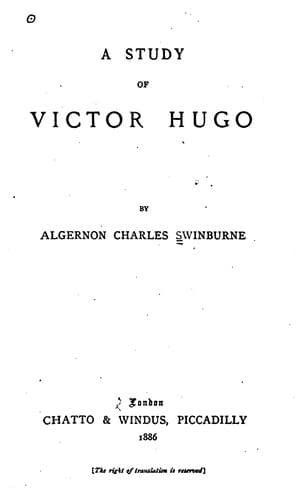
Hugo, Victor, 1802-1885 -- Criticism and interpretation
undoubtedly plausible proposition: but, be that as it may, I must take
leave to doubt yet more emphatically the implied conclusion that the
best or the only good witness procurable on a question of right and
wrong is one too impartial to feel enthusiasm or indignation; that
indifference alike to good and evil is the sign of perfect equity and
trustworthiness in a judge of moral or political questions; that a man
who has witnessed a deliberate massacre of unarmed men, women, and
children, if he be indiscreet enough to describe his experience in any
tone but that of a scientific or æsthetic serenity, forfeits the
inherent right of a reasonable and an honorable man to command a
respectful and attentive hearing from all honorable and reasonable men.
But valuable and precious as all such readers will always hold these two
book of immediate and implacable history, they will not, I presume, be
rated among the more important labors of their author's literary life.
No one who would know fully or would estimate aright the greatest genius
born into the world in our nineteenth century can afford to pass them by
with less than careful and sympathetic study: for without moral sympathy
no care will enable a student to form any but a trivial and a frivolous
judgment on writings which make their primary appeal to the
conscience--to the moral instinct and the moral intelligence of the
reader. They may perhaps not improperly be classed, for historic or
biographic interest, with the _Littérature et Philosophie mêlées_
which had been given to the world in 1834. From the crudest impressions
of the boy to the ripest convictions of the man, one common quality
informs and harmonizes every stage of thought, every phase of feeling,
every change of spiritual outlook, which has left its mark on the
writings of which that collection is composed; the quality of a pure, a
perfect, an intense and burning sincerity. Apart from this personal
interest which informs them all, two at least are indispensable to any
serious and thorough study of Hugo's work: the fervent and reiterated
intercession on behalf of the worse than neglected treasures of
mediaeval architecture then delivered over for a prey to the claws of
the destroyer and the paws of the restorer; the superb essay on
Mirabeau, which remains as a landmark or a tidemark in the history of
his opinions and the development of his powers. But the highest
expression of these was not to be given in prose--not even in the prose
of Victor Hugo.
Public-domain text, read in full here on John Shaqi.
Reviews
Reviews
No reviews yet
Be the first to share your thoughts on this work.
Join the Discussion
Join the discussion
Sign in to leave a comment or review.
Sign InorCreate an account