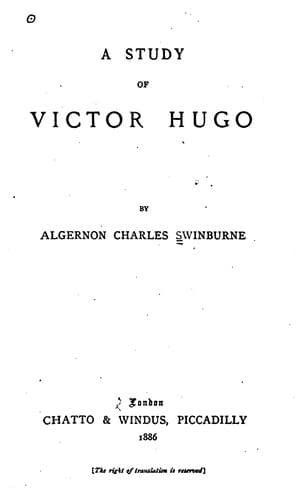
Hugo, Victor, 1802-1885 -- Criticism and interpretation
The fourth book, as most readers will probably remember, contains the
poems written in memory of Victor Hugo's daughter, drowned by the
accidental capsizing of a pleasure-boat, just six months and seventeen
days after her marriage with the young husband who chose rather to share
her death than to save himself alone. These immortal songs of mourning
are almost too sacred for critical appreciation of even the most
reverent and subdued order. There are numberless touches in them of such
thrilling beauty, so poignant in their simplicity and so piercing in
their truth, that silence is perhaps the best or the only commentary on
anything so "rarely sweet and bitter." One only may perhaps be cited
apart from its fellows: the sublime little poem headed _Mors._
Je vis cette faucheuse. Elle était dans son champ.
Elle allait à grands pas moissonnant et fauchant,
Noir squelette laissant passer le crépuscule.
Dans l'ombre où l'on dirait que tout tremble et recule,
L'homme suivait des yeux les lueurs de sa faulx.
Et les triomphateurs sous les arcs triomphaux
Tombaient; elle changeait en désert Babylone,
Le trône en échafaud et l'échafaud en trône,
Les roses en fumier, les enfants en oiseaux,
L'or en cendre, et les yeux des mères en ruisseaux.
Et les femmes criaient: Rends-nous ce petit être.
Pour le faire mourir, pourquoi l'avoir fait naître?
Ce n'était qu'un sanglot sur terre, en haut, en bas;
Des mains aux doigts osseux sortaient des noirs grabats;
Un vent froid bruissait dans les linceuls sans nombre;
Les peuples éperdus semblaient sous la faulx sombre
Un troupeau frissonnant qui dans l'ombre s'enfuit:
Tout était sous ses pieds deuil, épouvante et nuit.
Derrière elle, le front baigné de douces flammes,
Un ange souriant portait la gerbe d'âmes.
The fifth book opens most fitly with an address to the noble poet who
was the comrade of the author's exile and the brother of his
self-devoted son-in-law. Even Hugo never wrote anything of more stately
and superb simplicity than this tribute of fatherly love and praise, so
well deserved and so royally bestowed. The second poem, addressed to the
son of a poet who had the honor to receive the greatest of all his kind
as a passing guest in the first days of his long exile, is as simple and
noble as it is gentle and austere. The third, written in reply to the
expostulations of an old friend and a distant kinsman, is that admirable
vindication of a man's right to grow wiser, and of his duty to speak the
truth as he comes to see it better, which must have imposed silence and
impressed respect on all assailants if respect for integrity and genius
were possible to the imbecile or the vile, and if silence or abstinence
from insult were possible to the malignant or the fool The epilogue,
appended nine years later to this high-minded and brilliant poem, is as
noble in imagination, in feeling, and in expression, as the finest page
in the _Châtiments._
_ÉCRIT EN 1855_
Public-domain text, read in full here on John Shaqi.
Reviews
Reviews
No reviews yet
Be the first to share your thoughts on this work.
Join the Discussion
Join the discussion
Sign in to leave a comment or review.
Sign InorCreate an account