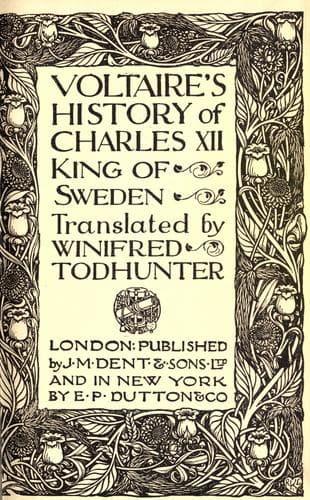
Voltaire's history of Charles XII, king of SwedenVoltaire
Philosophy
Voltaire's history of Charles XII, king of Sweden
Voltaire
Charles XII, King of Sweden, 1682-1718
Charles received all these prisoners with as charming and engaging a
manner as if he were feting them in his own Court. He only put the
general officers under a guard; all the under officers and soldiers
were disarmed and taken to the river Narva, where they were provided
with boats to convey them to their own country. In the meantime night
came on, and the right wing of the Russian force was still fighting.
The Swedes had not lost 1,500 men; 18,000 Russians had been killed in
their entrenchments, many had been drowned, many had crossed the river;
but still there remained enough to entirely exterminate the Swedes.
But it is not the number lost, but the panic of survivors which spells
defeat in war. The King made haste to seize the enemy’s artillery
before nightfall. He took up an advantageous position between their
camp and the town, and there got some hours’ sleep on the ground,
wrapped in his cloak, waiting till at daybreak he could fall on the
enemy’s left wing, which was not yet completely routed.
At two o’clock in the morning General Wade, who was in command of
that wing, having heard of the King’s gracious reception of the other
generals and his sending home of the subalterns and soldiers, asked
the same favour of him. The conqueror sent him word that he need
only approach at the head of his troops and surrender his arms and
standards. Soon the general appeared with his Russians, to the number
of about 30,000. Soldiers and officers marched bare-headed in front of
less than 7,000 Swedes. As the soldiers passed before him they threw
down their muskets and swords; the officers surrendered their ensigns
and colours.
He let the whole band cross the river without keeping one single
prisoner. Had he put them under guard the number of prisoners would
have been at least five times that of the conquerors.
He then victoriously entered Narva, attended by the Duke of Croy and
the other Russian officers; he ordered their swords to be restored to
them, and when he heard that they wanted money, because the tradesmen
of Narva refused to trust them, he sent the Duke of Croy 1,000 ducats,
and 500 to every Russian officer, who were full of admiration for this
treatment, which they had never conceived possible. An account of the
victory was at once drawn up to send to Stockholm, and to the allies,
but the King erased with his own hands whatever redounded too much to
his own credit or to the discredit of the Czar. His modesty could not
hinder them from striking several medals to commemorate the event at
Stockholm. One of these represented him, on one face, standing on a
pedestal, to which a Russian, Dane and Pole were chained; and on the
reverse a Hercules, armed with a club, trampling a Cerberus, and the
inscription, “Tres uno contudit ictu.”
Public-domain text, read in full here on John Shaqi.
Reviews
Reviews
No reviews yet
Be the first to share your thoughts on this work.
Join the Discussion
Join the discussion
Sign in to leave a comment or review.
Sign InorCreate an account