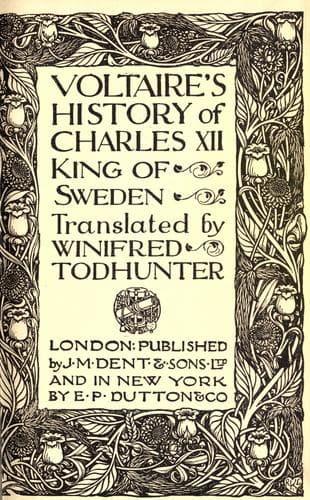
Voltaire's history of Charles XII, king of SwedenVoltaire
Philosophy
Voltaire's history of Charles XII, king of Sweden
Voltaire
Charles XII, King of Sweden, 1682-1718
Among the prisoners made on the day of the battle of Narva was one who
was typical of the revolutions of fortune. He was the eldest son and
heir of the King of Georgia. He was called the “Czarafis,” a name which
means son of the Czar among all the Tartars as well as in Russia; for
the word Czar meant King among the ancient Scythians, from whom all
these peoples are descended, and is not derived from the name of the
Cæsars, so long unknown to these barbarians. His father, Mitelleski,
who was master of the most beautiful part of the country between the
mountains of Ararat and the eastern extremity of the Black Sea, had
been driven from his kingdom by his own subjects in 1688, and preferred
throwing himself on the mercy of the Emperor of Russia, to applying to
the Turks. This king’s son, at the age of nineteen, helped Peter the
Great in his expedition against the Swedes, and was taken in battle
by some Finnish soldiers, who had already stripped him, and were on
the point of killing him, when Count Renschild rescued him from their
hands, supplied him with clothes, and presented him to his master.
Charles sent him to Stockholm, where the wretched prince died shortly
after. When he took leave, the King made aloud a natural reflection on
the strangeness of the fate of an Asiatic prince, born at the foot of
the Caucasus, and going to live a prisoner among the snows of Sweden:
“It is just,” he said, “as if I were to be one day prisoner among the
Tartars of the Crimea.” At that time these words made no impression,
but afterwards, when the prediction had been justified in the event,
there was but too much reason to remember them.
The Czar was advancing by long marches with a force of 40,000 Russians,
expecting to surround his enemy on all sides. When he had got half-way
he heard of the battle of Narva, and the dispersal of his whole camp.
He thought it best not to attack a victor who had shortly before
destroyed 100,000 entrenched troops, with a force of 40,000 raw
and undisciplined men. He retraced his steps, hoping to discipline
his troops at the same time as civilize his subjects. “I know,” he
remarked, “that the Swedes will long beat us, but in time they will
teach us to beat them.” Moscow, his capital, was terror-stricken to
hear of this defeat. So great was the pride and ignorance of the people
that they were convinced they had been conquered by superhuman agency,
and that the Swedes had secured their victory by magic. This opinion
was so widespread that a public prayer to Saint Nicholas, patron saint
of Russia, was ordered. This prayer is too singular to be omitted. It
runs thus--
Public-domain text, read in full here on John Shaqi.
Reviews
Reviews
No reviews yet
Be the first to share your thoughts on this work.
Join the Discussion
Join the discussion
Sign in to leave a comment or review.
Sign InorCreate an account